


Question
N, O, Q, R, S and U are standing in straight line facing north. Who among the following is between R and U?
N, O, Q, R, S and U are standing in straight line facing north. Who among the following is between R and U?
I. U stand second to the right of R. U is an immediate neighbour of O and Q. S is second to the right of Q.
II. There are three persons between O and S. O is not at the extreme ends of the row but is second to the left of Q.
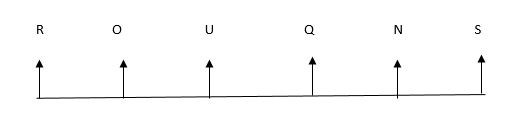 O stands between R and U. Hence statement I alone is sufficient to answer the question. From II, There is no information about R and U. So statement II alone is not sufficient to answer the question.
 More Data Sufficiency Questions
- The question given below consists of three statements numbered I, II and III below them. You have to decide whether the data provided in the statements are...
- Each of the questions below, consists of a question and three statements numbered I, II and III. You have to decide whether the data provided in the statem...
- Which direction is Sakshi facing? I. If Minakshi who is currently facing South, turns 900 towards left, she would face the same direction as Sakshi. II. ...
- J, K, L, M and N are sitting around a circular table facing the centre. Who are the immediate neighbours of J? I. J is third to the right of K, who is on ...
- Among six persons F, G, H, I, J, and K, who is second tallest? I. F is shorter than only two persons and I is taller than only J. II. H is taller than o...
- How many pages are there in the book? I. Lesson 8 and 9 take only 20 pages and at least five lessons take 13 pages each. II. There are 14 lessons in the...
- How many students are there in class 10 in the school X? I. The class teacher of class 10 correctly remembers that the number of students in her class is m...
- The question consists of two statements numbered I and II given below it. You have to decide whether the data provided in the statements are sufficient to ...
- How many children does Mr. Jagdish has? I. Mr. Jagdish has six sons and each has one sister. II. Number of sons of Mr. Jagdish is six times the number of h...
- Six persons D, E, F, G, H, and I have different heights. Who is the tallest person? Statement I: F is shorter than D. G is taller than I but shorter than F...
Hey! Ask a query
Please enter email id
The email must be a valid email address.
Please enter Mobile Number
Please enter valid Mobile Number
Please enter your Doubt

Think You're Ready for RBI Grade B?
RBI Grade B 2026 Phase 1 Memory Based Paper
- 200 Questions with Detailed Solutions
- Section-wise Coverage (GA, English, Quant & Reasoning)