


Question
B likes ______
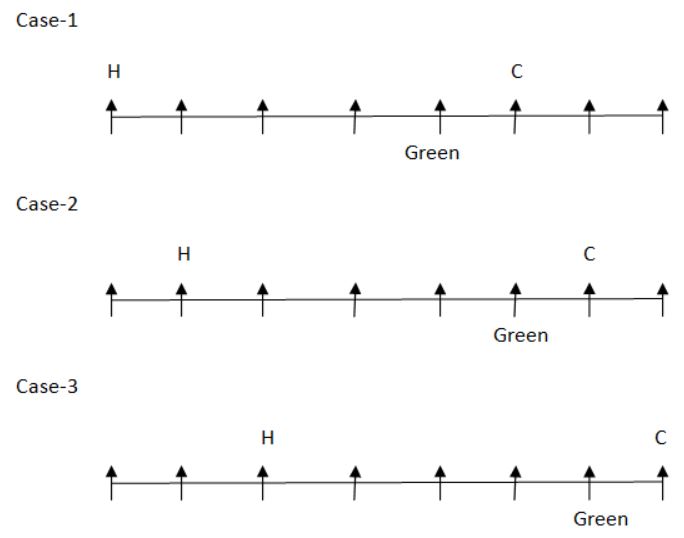 Two persons were seated between C and the one who likes Pink. F and the one who likes Pink were immediate neighbours. Two persons were seated between F and the one who likes Red. H does not like Red.
 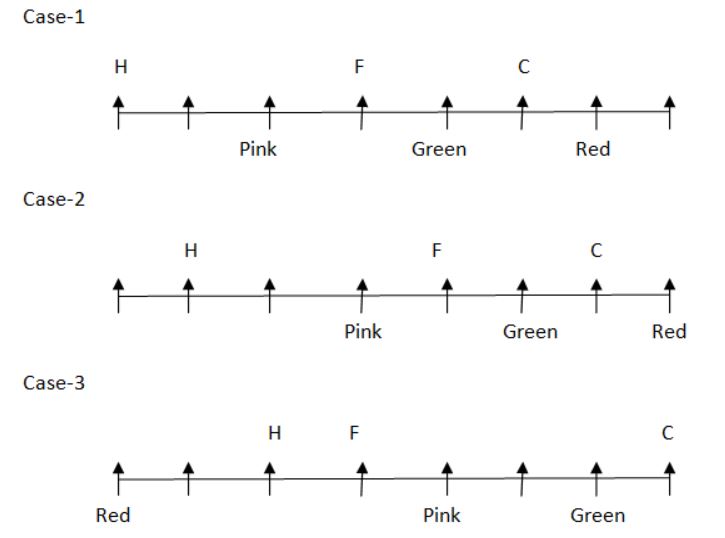 The number of persons seated to the left of the one, who likes Red was the same as between the number of persons seated to the right of the one who likes Blue. Two persons were seated between D and the one who likes Orange. Neither C nor F likes Orange.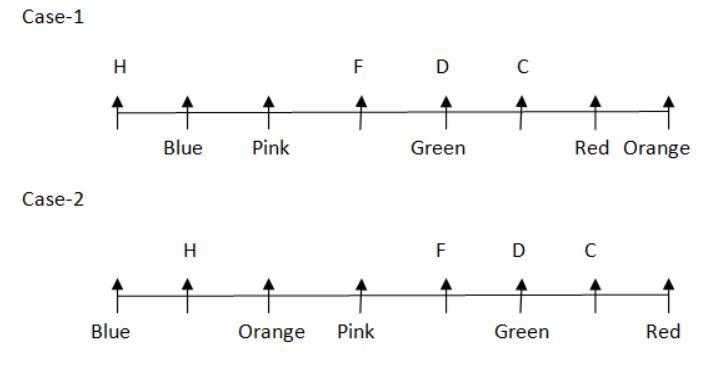
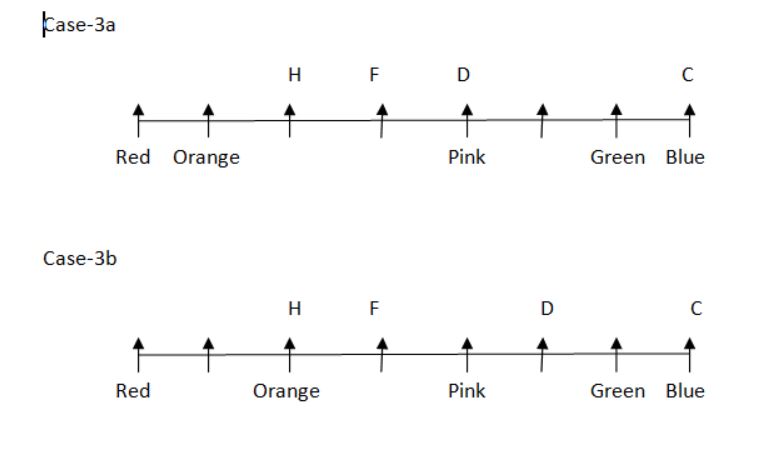 The number of persons seated between A and the one who likes Black was the same as between E and the one who likes Orange. The one who likes White seated second to the right of A. G and the one who likes Yellow were immediate neighbours. B neither like Blue nor Yellow.
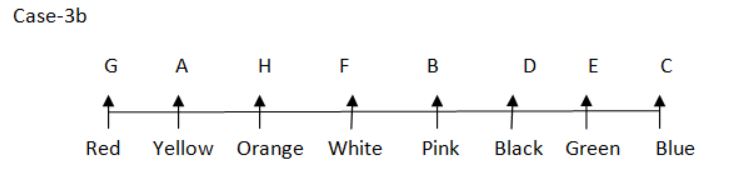 Case 1 and case 2 are invalid because the number of persons seated between A and the one who likes Black was the same as between E and the one who likes Orange. Case 3a is invalid because G and the one who likes Yellow were immediate neighbours. So, the final arrangement is
More Seating Arrangement Questions
- What is the position of Q with respect to O?
- If P is related to Kanpur, S is related to Jaipur in the given arrangement, Following the same pattern how is U related to ?
- How many persons sit between E and A from the right of E?
- How many persons are sitting between person R and person T?
- Seven friends, A0, B0, C0, D0, E0, F0 and G0 are sitting in a straight line, facing north. Only two people sit to the right of E0. Only two people sit betw...
- Who amongst the following is an immediate neighbour of the one who likes Black?
- Who sits in front of F?
- What is the position of O with respect to D?
- Who sits fifth to the right of M?
- Five products, K, L, M, N and O, are placed in a row facing towards the east (not necessarily in the same order). M is second to the left of U. K is second...
Relevant for Exams:
Hey! Ask a query
Please enter email id
The email must be a valid email address.
Please enter Mobile Number
Please enter valid Mobile Number
Please enter your Doubt

Think You're Ready for RBI Grade B?
RBI Grade B 2026 Phase 1 Memory Based Paper
- 200 Questions with Detailed Solutions
- Section-wise Coverage (GA, English, Quant & Reasoning)