


Question
Which of the following is true?
 Only two persons sit between G and the one who has likes Black. From this statement, we will have two cases: G will sit either at place no. 2 or 8. H is an immediate neighbour of C. C is not an immediate neighbour of A or E and he does not likes Black. The one who likes Green sits second to the right of H. C cannot sit at place no. 6, 5, 4 and 8. So, only place left for him is place no. 1. As H is an immediate neighbour of C. So, H will sit either at place no. 8 or 2. The one who likes Green sits either at place no. 4 or 2. Only three people sit between the one who likes Green and the one who likes Yellow. So, the one who likes Yellow sits either at place no. 6 or 8. F sits second to the left of the one who likes Yellow. So, F sits either at place no. 4 or 6. CASE-1
 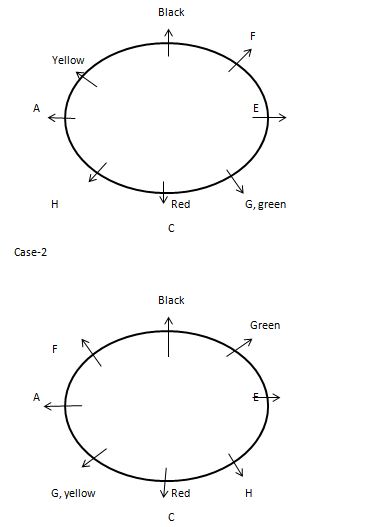 H does not likes Blue. The one who likes Blue is not an immediate neighbor of H. D sits on the immediate left of the one who likes Blue. The one who likes Pink sits on the immediate right of the one who likes Cream. Case 1 will get discarded as the one who likes Blue cannot sit at place no. 7 and 8. If the one who likes Blue sits either at place no. 4 or 3, then there is no place for D as D sits on the immediate left of the one who likes Blue In case 2, if the one who likes Blue sits at place no. 6, then D sits at place no. 5. The one who likes Pink and the one who likes Cream sit at place no. 3 and 2 respectively Only person left for place no. 4 is B. Only colour left for A is White Case-1
 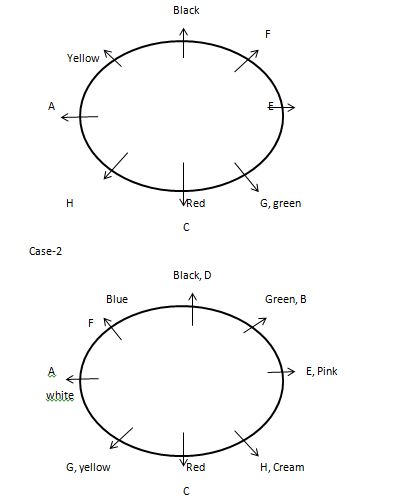 Final arrangement as shown below:
More Seating Arrangement Questions
- The number of persons sits between R and S is the same as between O and _____, when counted from the right of both S and O?
- D, E, F, G, H, I and J are sitting in a straight line, facing north. Only two people sit to the left of E. Only three people sit between E and H. Only one ...
- A, B, C, D and E are sitting on a bench. A is sitting next to B, C is sitting next to D, D is not sitting with E who is on the left end of the bench. C is ...
- Which of the following statement is/are correct? i) E and T like same Car ii) R sits second to the right of Q iii) C is an immediate neighbour of E and...
- Who likes Star Maa channel?
- Seven friends A, B, C, D, E, F and G are sitting around a circular table facing towards the centre(not necessarily in the same order). A is third to the le...
- Five persons M, N, O, P and Q are sitting in a row facing north. M is sitting third to the right of N. P sits second to the left of M. Q sits at one of the...
- How is X related to D?
- Which of the following statement is not true?
- If all the persons are arranged in alphabetical order in the clockwise direction with respect to A, then how many persons remain unchanged in their positio...
Hey! Ask a query
Please enter email id
The email must be a valid email address.
Please enter Mobile Number
Please enter valid Mobile Number
Please enter your Doubt

Think You're Ready for RBI Grade B?
RBI Grade B 2026 Phase 1 Memory Based Paper
- 200 Questions with Detailed Solutions
- Section-wise Coverage (GA, English, Quant & Reasoning)