


Question
All the letters provided below are arranged in English alphabetical order from left to right. Then in each combination, the first letter from the left end is numbered as I, the second letter from the left end is numbered as II, and so on. Hence in each combination, I, II, III, IV, and V will denote the position of the letters from the left end. [i] RQWZJ [ii] CAEJM [iii] FPDBE [iv] FDLZX From each of the given words, the letters, which are at the same positions are clubbed together. The letters which are at position [I] will form a word if taken in order of combination [i], [ii], [iii], and [iv] respectively and similarly form [I II III IV and V]. Then, how many meaningful words will be formed?
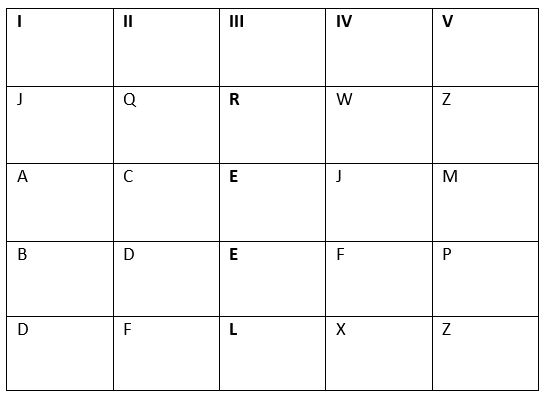 Only III will make a meaningful word i.e. ‘REEL’.
More Commonsense Reasoning Questions
- If a meaningful four-letter English word is formed by using the 2nd, 5th, 6th and 10th letter (from the left end) of the word ‘HIBERNATION’ then which of t...
- If in the word ‘DEFAMATION’, all the consonants are changed to their immediate succeeding letters and all the vowels are changed to their opposite letters ...
- When letters of the word ‘MONETISATION’ are arranged in reverse alphabetical order from left to right, then how many vowels are there between S and fifth l...
- How many such pairs of letters are there in the word TELEVISION each of which has as many letters between them in the words (both in backward and forward d...
- In the word ‘INTELLIGENCE’, the first letter goes to 12th position and 12th goes to 1st, the second goes to 11th position and 11th goes to 2nd, 3rd goes to...
- If all the prime digits of the number 9745976129 are written first (in increasing order) followed by even digits(in increasing order) and then odd digits (...
- How many pairs of letters are there in the word ‘MOUNTAIN’ that maintain the same relative positioning as in the English alphabetical series (both forward ...
- When all the vowels of the word 'MANIPULATION' are written first followed by the consonants in alphabetical order from left to right, how many letters are ...
- If all the digits of the number ‘9723654’ are arranged in ascending order from left to right, the position of how many digits will remain unchanged?
- If we arrange all the vowels of the word "PLAYLIST" in ascending order first and then all the consonants in ascending order as per English alphabetical ser...
Relevant for Exams:
Hey! Ask a query
Please enter email id
The email must be a valid email address.
Please enter Mobile Number
Please enter valid Mobile Number
Please enter your Doubt

Think You're Ready for RBI Grade B?
RBI Grade B 2026 Phase 1 Memory Based Paper
- 200 Questions with Detailed Solutions
- Section-wise Coverage (GA, English, Quant & Reasoning)