


Question
Which of the following combination is definitely true?
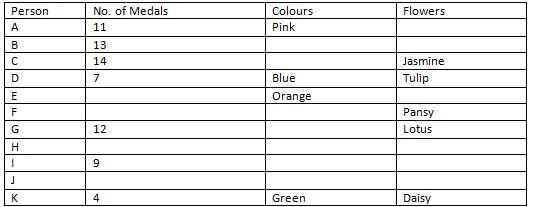 Neither H nor J like Black. The one who likes Black won 8 medals. (only possibility is F likes Black).
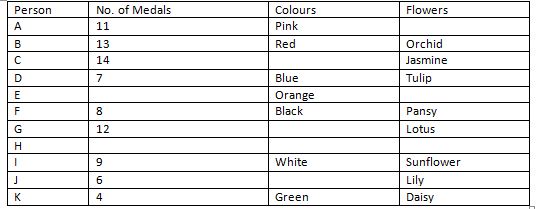
  It is given that, H does not like Lily and The one who likes Lily won 6 medals. E won more than 8 medals. (only possibility is J likes Lily). The one who likes Orchid likes Red. And it is also given that neither H nor I like Orchid. (only possibility is B likes Orchid). H does not like Sunflower and one who likes sunflower likes White. (so, only possibility is I likes Sunflower).
  E has won more than 8 medals and it is also given that he neither likes Iris nor Rose. (so, only possibility is E won 10 medals and likes Marigold). One who has won more number of medals than B likes Yellow.(i.e. C must likes Yellow). Neither H nor J like either Black or Gray. (only possibility is G likes Gray). After filling the remaining data, we get: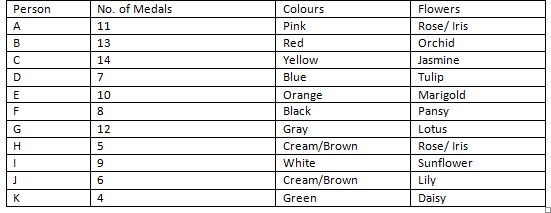
More Puzzles Questions
- Who among the following person likes banana?
- What will be the difference between the marks secured by E and D?
- Who among the following plays Rugby?
- How many rows are occupied between Anuj and Chunnu?
- In the given words, if the 3rd and 6th (from the left end) letters are exchanged and same is done with 4th and 9th letters, 5th and 10th letters, then whi...
- Who among the following live on the odd floor? I. R II. N III. O
- Who among the following lives on the floor immediately above the floor of G?
- Seven persons R, S, T, U, V, W and X has an exam on a different day of a week starting from Monday and ending on Sunday of the same week. S has exam on Fri...
- What is the position of B with respect to the one who likes Sprite?
- What is Rahul by profession?
Relevant for Exams:
Hey! Ask a query
Please enter email id
The email must be a valid email address.
Please enter Mobile Number
Please enter valid Mobile Number
Please enter your Doubt

Think You're Ready for RBI Grade B?
RBI Grade B 2026 Phase 1 Memory Based Paper
- 200 Questions with Detailed Solutions
- Section-wise Coverage (GA, English, Quant & Reasoning)