


Question
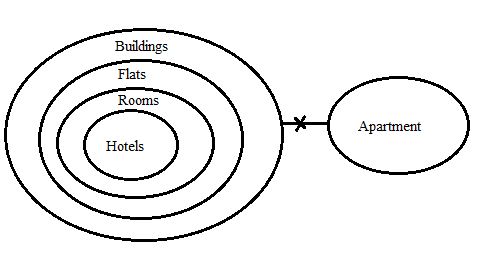
Statement : All hotels are rooms. All rooms are flats. All flats are buildings. No building is apartments. Conclusion : Some buildings may not be rooms. Some apartments are not flats. Some apartments are flats. All hotels are buildings.
More Important Reports and Indices Questions
- Which control does access use to link data access page components to access data?
- The average age of a group of students in a school is 14 years. If 20% of them have an average age of 12 years and 40% have an average age of 16 years, the...
- Select the most appropriate word to fill in the blank. We respect you but we don’t agree ______ your ideas.
- A word has been given, followed by some words, one of which cannot be formed by using the letters of the word “FRIGHTEN”. Find that word?
- Find the greatest number of four digits which is exactly divisible by 8,12, 32 and 60?
- Point D is 3m to the West of Point R. Point A is 6 m to the North of point D. Point K is 16 m to West of point A. Point K forms a midpoint of the vertical ...
- Which among the following is the primary function of a scanner?
- What type of web technology creates an online community where people can make statements and others can read and respond to those statements ?
- The H.C.F of two numbers is 7 and their L.C.M is 495. If one of the numbers is 55, find the other?
- The average salary of the entire staff in an office is Rs. 30000 per month. The average salary of officers is Rs. 40000 and that of non-officers is Rs. 250...
Relevant for Exams:
Hey! Ask a query
Please enter email id
The email must be a valid email address.
Please enter Mobile Number
Please enter valid Mobile Number
Please enter your Doubt

Think You're Ready for RBI Grade B?
RBI Grade B 2026 Phase 1 Memory Based Paper
- 200 Questions with Detailed Solutions
- Section-wise Coverage (GA, English, Quant & Reasoning)