


Question
Which of the following statement is correct about K5?
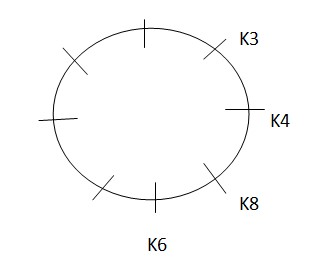 Case II: When K4 sits to the left of K6. K2 sits 3rd to the left of K3 so, case II is invalid, because K2 can’t be placed in case II.
 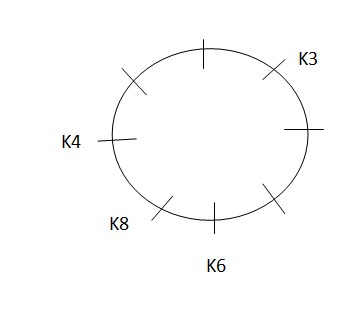 K1 sits second to the left of K2, K1 faces the same direction as K6. Immediate neighbors of K1 face the same direction. K2 sits 3rd to the left of K3. K4 and K2 face opposite directions. Immediate neighbours of K6 face the opposite direction as of K1. Neither K7 nor K5 is an immediate neighbor of K3. K5 doesn’t sit immediate right of K2. The second possibility gets eliminated as it is not possible to place K2 third to the left of K3. So, K2 faces towards the center. K1 and K6 also faces towards the center. The final arrangement is as follows: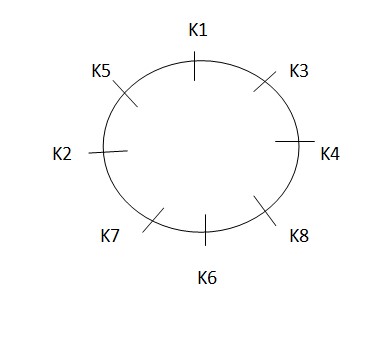
More Seating Arrangement Questions
- Four friends O, P, Q and R are sitting in a row facing south. P and Q are sitting at an extreme end of the row. O is sitting between P and R and sits seco...
- Answer the following questions based on the information given below. If A@B means A is the son of B. A#B means A is the father of B. A$B means A is the...
- Six persons D, E, F, G, H and I sit in a straight row facing north. I sits third to the right of H. D sits immediate left of G. G sits third to the left of...
- If Z is at extreme right end, then how many persons are sitting Z and H?
- Five products, K, L, M, N and O, are placed in a row facing towards the east (not necessarily in the same order). M is second to the left of U. K is second...
- Z, Y, X, W, T, S, R and Q are eight colleagues, sitting around a circular table at equal distance to each other facing the centre, not necessarily in the s...
- Seven people, P, Q, R, S, T, U and V, are sitting in a row, facing north. Only five people sit to the right of P. Only five people sit to the left of Q. U ...
- Eight students – Pi, Qi, Ri, Si, Ti, Ui, Vi, and Wi are sitting around a circular bench, facing the centre. Pi is sitting third to the left of Wi and thir...
- Who is third to the left of S?
- Which of the following is R’s position?
Relevant for Exams:
Hey! Ask a query
Please enter email id
The email must be a valid email address.
Please enter Mobile Number
Please enter valid Mobile Number
Please enter your Doubt

Think You're Ready for RBI Grade B?
RBI Grade B 2026 Phase 1 Memory Based Paper
- 200 Questions with Detailed Solutions
- Section-wise Coverage (GA, English, Quant & Reasoning)