


Question
On which of the following floor number does D live?
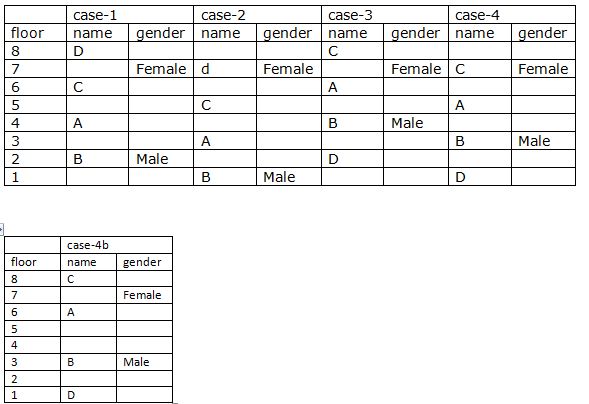 The number of persons lives above G is one more than the number of persons lives below E. Neither A nor G is female. At most two people live above G. D doesn’t sit adjacent to E. D lives above C. H lives above F, who is male.
More Ranking Questions
- Statement : "The train service will offer additional coaches during the festive season." Assumptions : I. The number of passengers increases during the f...
- How is T related to S?
- All 56 students in a class are standing in a row facing north. Vivek is 25th from the right end and Suman is 12th from left end. How many students are stan...
- Answer the questions based on the information given below: Seven students D, E, F, G, H, I and J score different marks. J scored more than only three stud...
- How many students scored more marks than V?
- Mohan is ranked 11th from the top in his class. When counted from the bottom, he is ranked 40th. What is the total number of students in the class?
- In a row of 10 boys, when Harish was shifted by 5 places towards the left, he became the 3rd from the left end. What was his earlier position from the righ...
- Which among the following boxes are kept between X and Y?
- In a class of 24 students, Divya is sixth from the left and Rohan is three places to the right of Divya, and Amit is two places to the left of Rohan. What ...
- Arrange the following words in a logical and meaningful order.1. Results2. Polling3. Sworn4. Nominations5. Counting of votes
Hey! Ask a query
Please enter email id
The email must be a valid email address.
Please enter Mobile Number
Please enter valid Mobile Number
Please enter your Doubt

Think You're Ready for RBI Grade B?
RBI Grade B 2026 Phase 1 Memory Based Paper
- 200 Questions with Detailed Solutions
- Section-wise Coverage (GA, English, Quant & Reasoning)