


Question
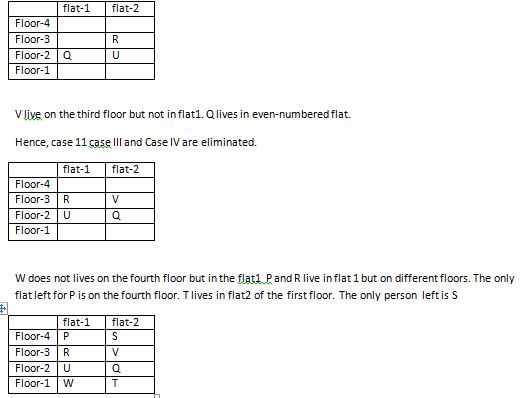
Who live in the flat 1 of floor 2?
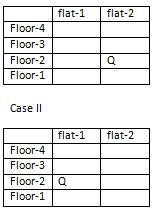 U lives with Q who lives two floors below S. R lives one floor above the floor on which Q lives. Case I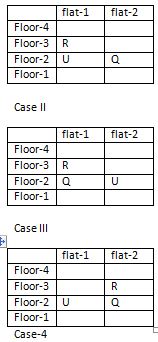
More Ranking Questions
- Answer the questions based on the information given below. Eight furniture items i.e., Sofa, Table, Bed, Desk, Cabinet, Chair, Bookshelf and Wardrobe, ha...
- Answer the following questions based on the information given below. Seven persons T, U, V, W, X, Y and Z has different weights. T is heavier than at lea...
- Answer the questions based on the information given below. Eight persons, L through S are of different weights. S is heavier than only L. Q is heavier t...
- Divisha is 47th from the left end of a row of 80 students and Praful is 59th from the right end in the same row. How many students are there between them i...
- All 28 students in a class are standing in a row facing north. Himani is 16th from the right end and Sheetal is 11th from left end how many students are st...
- Rohan's position from the left in a row of boys is 25th and Pranav's position from the right is 38th. After interchanging their position, Pranav becomes 48...
- Five boys N, O, P, Q and R are sitting in a row facing north. Each one has a different weight. The one who is second heaviest has a weight of 68 kg. N is l...
- Answer the questions based on the information given below. In a class, eight students J, K, L, M, N, O, P, and Q scored different marks. The marks of J i...
- Who among the following is second heaviest?
- Seven students J, K, L, M, N, O and P are going for an entrance examination. Only two students score more marks than J. M score more marks than N but less ...
Hey! Ask a query
Please enter email id
The email must be a valid email address.
Please enter Mobile Number
Please enter valid Mobile Number
Please enter your Doubt

Think You're Ready for RBI Grade B?
RBI Grade B 2026 Phase 1 Memory Based Paper
- 200 Questions with Detailed Solutions
- Section-wise Coverage (GA, English, Quant & Reasoning)