


Question
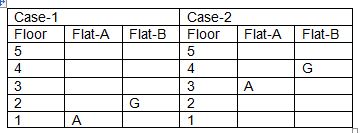
On which floor and in which flat does G lives?
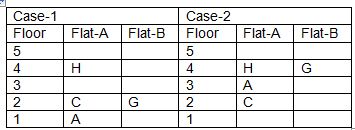
 C lives two flats below of H who lives on Floor-4 and in flat-A.
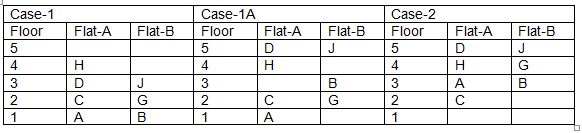
  D lives west of J, who lives second to above the flat of B Note: Here we get one more sub case from case-1
  I lives north-west of E Note: Case-2 rejected since I lives north-west of E is not possible.
 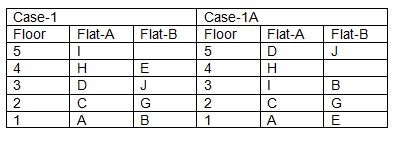 I and F don’t live in same floor. Note: Case-2 rejected since I and F don’t live in same floor is not possible. The final table arrangement is: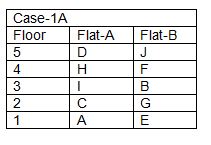
More Puzzles Questions
- Who among the following live immediately above V?
- Firoj was in which of the following rows?
- Who lives on the floor immediately above T?
- Who attends seminar in Pre-Noon on Wednesday?
- Who appears for the test of IIT Delhi?
- How is S related to Q?
- Who lives on the 4th floor?
- Find the correct match. I. DSP-SANJAY II. SI-ANKIT III. ASI-TARUN IV. HC-NAMAN V. CT- ANKIT
- ---------- lives on floor--------- in flat 3.
- Six boxes, A, B, C, D, E and F are placed one above another, such that the bottommost box is 1 and the box above it is 2 and so on. Three boxes are placed ...
Relevant for Exams:
Hey! Ask a query
Please enter email id
The email must be a valid email address.
Please enter Mobile Number
Please enter valid Mobile Number
Please enter your Doubt

Think You're Ready for RBI Grade B?
RBI Grade B 2026 Phase 1 Memory Based Paper
- 200 Questions with Detailed Solutions
- Section-wise Coverage (GA, English, Quant & Reasoning)