


Question
Who among the following person is the GM?
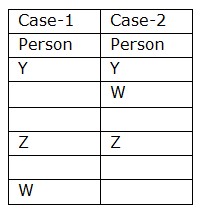 Again we have, More than two persons are designated between W and X, who is junior to Y. As many persons designated between Y and X is same as between U and Z. V is two persons junior to T. As many persons senior to T is same as junior to W. From the above conditions, case S and case Ia get eliminated. Hence case II shows the final arrangement.
 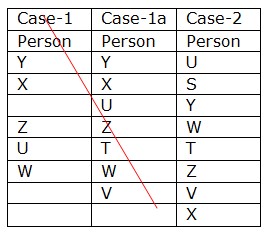 Hence case II shows the final arrangement.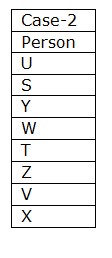
More Puzzles Questions
- In the meeting who is sitting immediately right to K?
- In a certain way, COO is related to W and PO is related to X, then MD is related to___?
- Who among the following lives immediately above the one whose age is 40?
- Who lives to the immediate east of Swati?
- Which of the following flower is filled in box D?
- Which of the following is true regarding E?
- Five subjects Physics, Chemistry, Hindi, English and Math (not necessarily in the same order) are taught from Monday to Friday. One day a subject is taught...
- D likes which of the following laptop?
- Which of the following statements is true about the one who likes Watermelon?
- Six boxes (S, T, U, V, W, and X) are kept one above another such that the bottommost box is numbered as 1 and the topmost box is numbered as 6 but not nece...
Hey! Ask a query
Please enter email id
The email must be a valid email address.
Please enter Mobile Number
Please enter valid Mobile Number
Please enter your Doubt

Think You're Ready for RBI Grade B?
RBI Grade B 2026 Phase 1 Memory Based Paper
- 200 Questions with Detailed Solutions
- Section-wise Coverage (GA, English, Quant & Reasoning)