


Question
Four among the following form a group in a certain way. Which of the following does not belong to group?
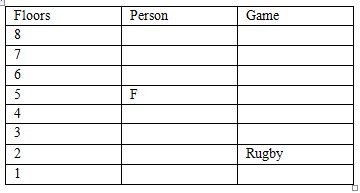
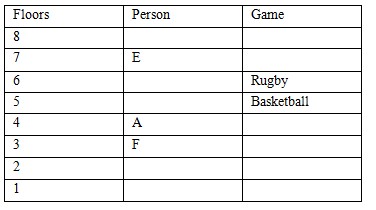 II condition – By II and IV Basketball can be either above or below F. So here we get two more conditions that is why we will hold this condition and move further with other conditions.
  III condition – By II and IV, C does not like Basketball. B lives on an even- numbered floor and just above C. By V and VI, The one who likes Table Tennis lives on an even- numbered floor and lives just above the person who likes Wrestling and H lives just below the one who likes Wrestling. By I and VI, the one who likes Volleyball lives on an even- numbered floor. Only two persons live between the one who likes Volleyball and the one who likes Football. This condition is not possible.
 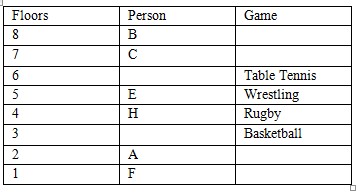 IV condition – By II and IV, C does not like Basketball. B lives on an even- numbered floor and just above C. By V and VI, The one who likes Table Tennis lives on an even- numbered floor and lives just above the person who likes Wrestling and H lives just below the one who likes Wrestling. By I and VI, the one who likes Volleyball lives on an even- numbered floor. Only two persons live between the one who likes Volleyball and the one who likes Football. By VI, Only one person lives between C and the one who likes Golf. D does not like Archery. So this condition is the final arrangement.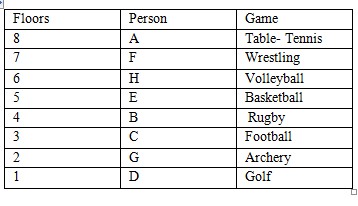
More Puzzles Questions
- Which of the following given pair is different from rest?
- Who among the following is the BO?
- Which of the following can be coded as ‘sip zdp’?
- Six boxes L, M, N, O, P and Q are kept one above another. The bottommost box is numbered as 1 and the topmost box is numbered as 6. L is three boxes below ...
- How many persons were born after C?
- At which place box B is kept in the stack?
- Who among the following were born in the same month?
- Who lives on 6th floor?
- In a certain way, COO is related to W and PO is related to X, then MD is related to___?
- P is going to office on which of the following day?
Hey! Ask a query
Please enter email id
The email must be a valid email address.
Please enter Mobile Number
Please enter valid Mobile Number
Please enter your Doubt

Think You're Ready for RBI Grade B?
RBI Grade B 2026 Phase 1 Memory Based Paper
- 200 Questions with Detailed Solutions
- Section-wise Coverage (GA, English, Quant & Reasoning)