


Question
How many boxes are kept between the boxes B and A?
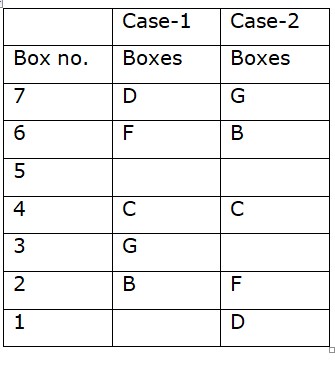 Box A is kept above box E, and more than two boxes are kept between them. So the final arrangement becomes: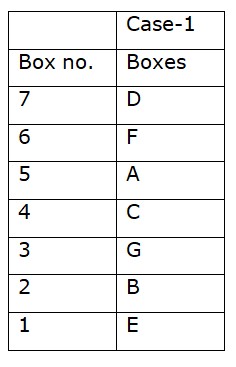
More Puzzles Questions
- Who among the following lives two floors above the floor on which B lives in the same flat?
- Who amongst the following age is 40?
- Who among the following has born on 17th of August?
- Who visits just before the one who has White?
- Who among the following person likes Toshiba?
- A is the mother of B. B is sister of C. C is husband of E. D is brother of E. F is the father of D. How is A related to E?
- Who doesn’t live in flat-B of their floors? I. T II. P III. R
- I has __ pens less than the ___.
- In the given words, if the 3rd and 6th (from the left end) letters are exchanged and same is done with 4th and 9th letters, 5th and 10th letters, then whi...
- Seven persons D, E, F, G, H, I and J live on seven different floors of a building such that bottommost floor is numbered as 1, the floor immediately above ...
Relevant for Exams:
Hey! Ask a query
Please enter email id
The email must be a valid email address.
Please enter Mobile Number
Please enter valid Mobile Number
Please enter your Doubt

Think You're Ready for RBI Grade B?
RBI Grade B 2026 Phase 1 Memory Based Paper
- 200 Questions with Detailed Solutions
- Section-wise Coverage (GA, English, Quant & Reasoning)