


Question
Who among the following person attends the seminar just after V?
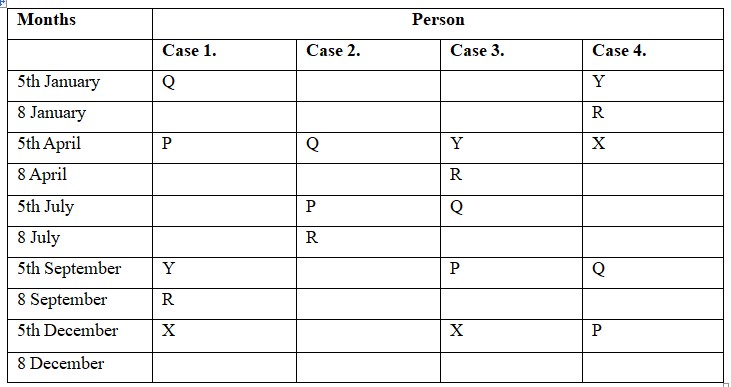 The number of persons is attending the seminar between Y and Q is the same as the number of persons is attending the seminar between P and X. In case 1, there are five person between Q and Y. So, X attends seminar on 5th December. In case 3, there is one person between Q and Y. So, X attends seminar on 5th December. In case 4, there are five person between Q and Y. So, X attends seminar on 5th April. U attends seminar three months before X, who attends seminar in one of the months has 31 days. Case 1 and 4 will get discarded as we know that X attends the seminar in December and U should have attended in September. In case 3, U attends seminar on 8 September
 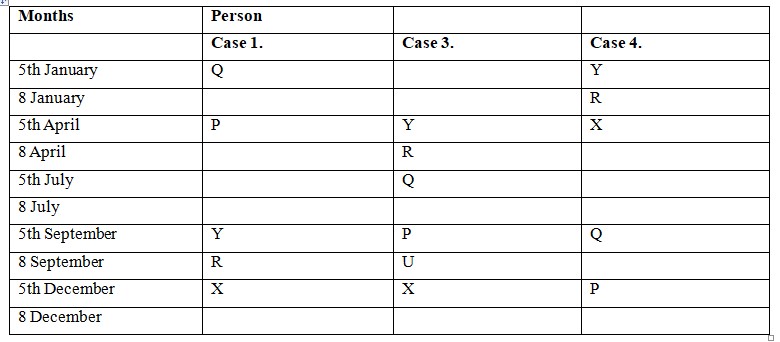 At least two persons attend the seminar between T and P. So, T attends seminar on 8 December. V attends seminar on the 8th of the month but not in January. Now it is clear that V attends the seminar on 8 July. The number of persons attending the seminar between U and R is one less than the number of persons is attending the seminar between W and V . W and S attend seminars in the same month. We know that three person are there between U and R. It means that there would have been four person between V and W. So, W and S attend seminar on 5th January and 8 January respectively.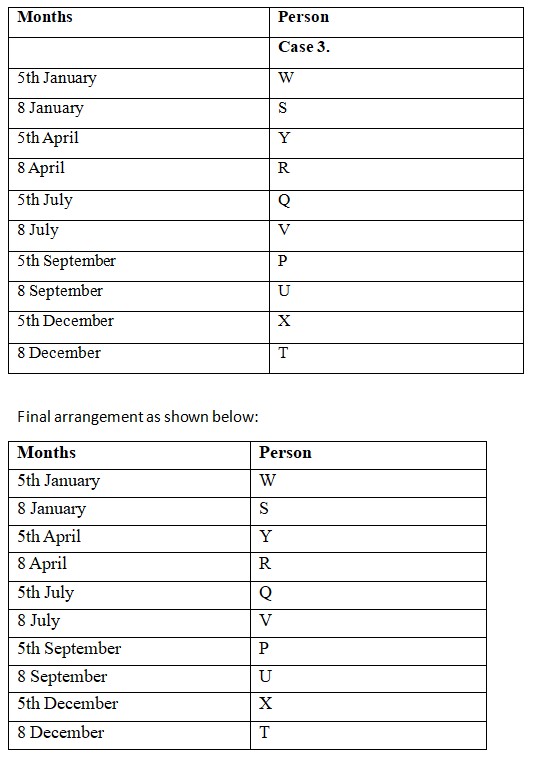
More Puzzles Questions
- Which of the following box is kept immediately above box A?
- There are seven shelves, S , T, U, V, W, Y and Z in a cupboard. The shelf, which is at the bottom, is numbered as 1, the shelf above it is numbered as 2 an...
- Four of the five among the following are similar in such a way to form a group, which one of following doesn’t belong to the group?
- Who appears for the test of IIT Delhi?
- Four of the following five are a like in a certain way based on the given arrangement and thus form a group. Which is the one that does not belong to that...
- If M is related to R, R is related to P then Q is related to?
- Four of the following five are alike in a certain way as per the given arrangement and thus form a group. Find the one that does not belong to that group.
- Which of the following statements is/are true according to the given information?
- Who lives on the same floor with A?
- Which of the following statements is correct?
Relevant for Exams:
Hey! Ask a query
Please enter email id
The email must be a valid email address.
Please enter Mobile Number
Please enter valid Mobile Number
Please enter your Doubt

Think You're Ready for RBI Grade B?
RBI Grade B 2026 Phase 1 Memory Based Paper
- 200 Questions with Detailed Solutions
- Section-wise Coverage (GA, English, Quant & Reasoning)