


Question
P likes which of the following colour/flower?
 Q likes Pink. Two people were born between P and Z.X does not like any Flower (it means X born on even number of days of month) One person was born between R and one who likes Pink
 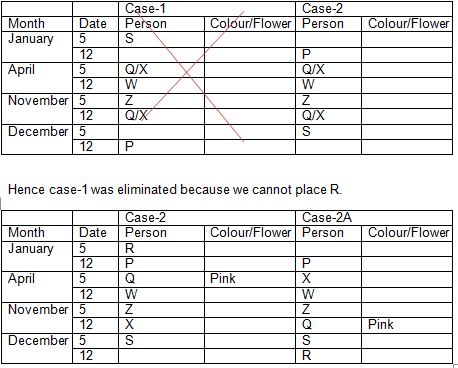 No person was born between Q and one who likes Lily flower. P does not like Lily flower. The ones who like Rose flower and Lily were born on same month.
 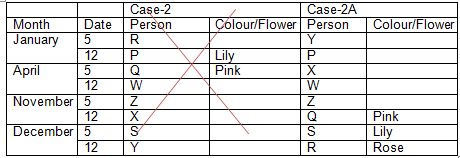 Case-2 was eliminated as P is not like Lily Two people were born between W and one who likes Sunflower flower. One person was born between the ones who like Red and Lotus flower. Number of persons was born between the ones who like Blue and Lotus flower is two Final arrangements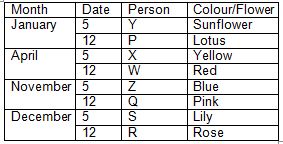
More Puzzles Questions
- How many such digits are there in the number ‘95746238571’ which will remain at the same position when they are arranged in the ascending order from left t...
- Who amongst the following lives exactly between the fourth floor and the one whose age is 20?
- A is the mother of B. B is sister of C. C is husband of E. D is brother of E. F is the father of D. How is A related to E?
- Choose the incorrect pair.
- Who among the following person has started on November 17th?
- In the word ‘SOMETIME’ all consonants are written as their preceding letter and all vowels are written as their following letters. Now all letters are arra...
- R attends the exam on which of the following subjects?
- Who among the following person doesn’t form a group?
- Find the correct match. I. DSP-SANJAY II. SI-ANKIT III. ASI-TARUN IV. HC-NAMAN V. CT- ANKIT
- Which of the following statements is/ are true regarding H?
Hey! Ask a query
Please enter email id
The email must be a valid email address.
Please enter Mobile Number
Please enter valid Mobile Number
Please enter your Doubt

Think You're Ready for RBI Grade B?
RBI Grade B 2026 Phase 1 Memory Based Paper
- 200 Questions with Detailed Solutions
- Section-wise Coverage (GA, English, Quant & Reasoning)