


Question
Which among the following statements is true?
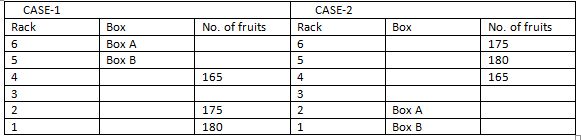 Box D has 210 fruits. Box which has 119 fruits is placed immediately above the box which has 190 fruits. Two boxes are placed between the box which has 190 fruits and Box E. Box C is placed above Box F but neither of the boxes is placed in the topmost rack. From above statements, Box D has 210 fruits and it is placed in 3rd rack (only possibility in both cases) Case-1: The boxes which have 119 and 190 fruits are placed in 6th and 5th rack respectively. Box E is placed in second rack. Finally, Box C and Box F are placed in 4th and 1st rack respectively. All the given condition satisfied and we get the completed arrangement as shown, Case-2: The boxes which have 119 and 190 fruits are placed in 6th and 5th rack respectively. Box E is placed in second rack. Either Box C or Box F is not placed in the topmost rack. Thus this case-2 becomes invalid and it can be eliminated. By using above information we get the following table as shown,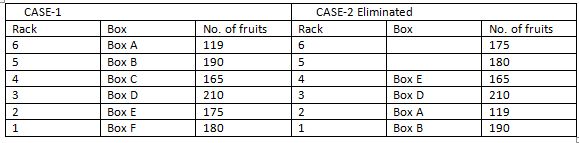
More Puzzles Questions
- Which among the following combination is correct?
- Who among the following person goes on Friday?
- How many persons are designated senior to A?
- What is the direction of A’s flat with respect to D’s flat?
- ___ and ___ don't live in same type of flat.
- Which combination represents Ishika’s favorite subject and the standard in which she studies?
- Who among the following read The Telegraph?
- Six persons, M, N, O, P, Q and R live in a building, which has six floors. The floor, which is at the bottom, is numbered as 1, the floor above it as 2 and...
- Who among the following visit North Korea?
- Which of the following box is kept just below the box which contains guava?
Relevant for Exams:
Hey! Ask a query
Please enter email id
The email must be a valid email address.
Please enter Mobile Number
Please enter valid Mobile Number
Please enter your Doubt

Think You're Ready for RBI Grade B?
RBI Grade B 2026 Phase 1 Memory Based Paper
- 200 Questions with Detailed Solutions
- Section-wise Coverage (GA, English, Quant & Reasoning)