


Question
Which of the following box is placed two boxes above box D in the same stack?
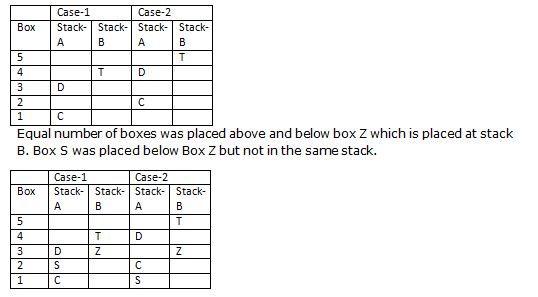 Box Q was placed two boxes above box S and immediately below box G, which is placed to the west of box E. Box F was not placed at the bottommost position. Hence, case 2 gets eliminated.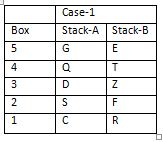
More Puzzles Questions
- F’s viva was held at?
- Who among the following lives at floor number 5?
- Who among the following lives on ground floor?
- Four of the following five are alike in a certain way based on the given arrangement and thus form a group. Which is the one that does not belong to that g...
- Which of the following box is kept just above box B?
- Which of the following combination is false?
- Who among the following born on 5th of February?
- Who among the following person attends seminar on 8th of January?
- Select the option that is related to the third term in the same way as the second term is related to the first term. DFB : GHC :: LNJ : ?
- Which of the following box is wrapped with Pink paper?
Relevant for Exams:
Hey! Ask a query
Please enter email id
The email must be a valid email address.
Please enter Mobile Number
Please enter valid Mobile Number
Please enter your Doubt

Think You're Ready for RBI Grade B?
RBI Grade B 2026 Phase 1 Memory Based Paper
- 200 Questions with Detailed Solutions
- Section-wise Coverage (GA, English, Quant & Reasoning)