


Question
How many rows are vacant?
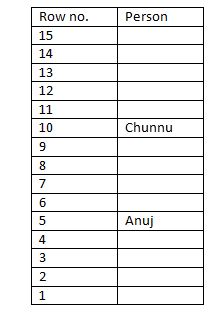 Case 2: When Anuj's seat number is 4
 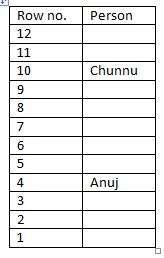 Eri was immediyately above Diya. Diya's row number was six times as that of Vani's row number. Case 1 breaks into one more case i.e. Case 1A
 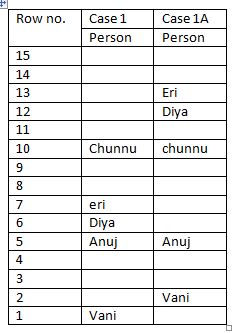 Case 2:
 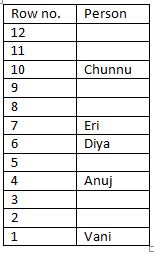 Firoj was seated in a prime numbered row somewhere above Eri and was not neighbouring Chunnu. Case 2 fails, as the only prime numbered row above Eri is 11 , which is neighbouring Chunnu. Case 1A fails, as there is no prime numbered row above Eri.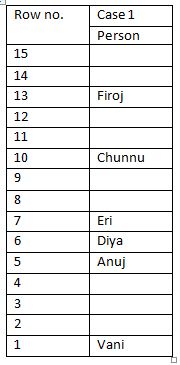
More Puzzles Questions
- Which of the following does not belong to the group?
- Which of the following is true regarding K?
- How many floors are there below the floor on which the one who likes Hockey lives?
- Which of the following statements is/ are true regarding H?
- What is the rank of M from the top as per given designation order?
- Who lives in the same flat of T?
- Which of the following students did not opt for Physics?
- Find the odd out of all the five?
- Which one of the following combinations of 'floor number - person - family members' is the correct one?
- __ lives to the south west of F
Relevant for Exams:
Hey! Ask a query
Please enter email id
The email must be a valid email address.
Please enter Mobile Number
Please enter valid Mobile Number
Please enter your Doubt

Think You're Ready for RBI Grade B?
RBI Grade B 2026 Phase 1 Memory Based Paper
- 200 Questions with Detailed Solutions
- Section-wise Coverage (GA, English, Quant & Reasoning)