


Question
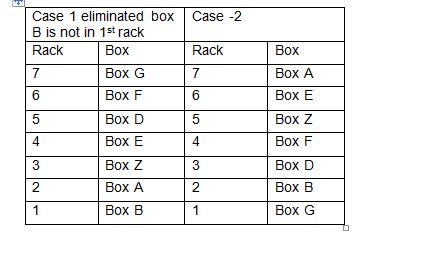
How many boxes are placed between Box A and Box B?
More Puzzles Questions
- How many people were born between A and one who likes Sandwich?
- How many seminars are conducted between seminars of C in afternoon and her seminar in pre-noon?
- Four of the following five are alike in a certain way and hence form a group. Which is the one that does not belong to the group?
- As many persons live between C and I is the same as the number of person lives between G and ___?
- How is S related to Q?
- On which floor does H live?
- Five persons, N, T, E, S and H, live in a five-storey building such that bottommost floor is numbered as 1 and the floor immediately above it is numbered a...
- Which of the following Flat is vacant?
- Who among the following lives at floor number 5?
- In a class of students, Rajesh ranks 15th from the top and Prakash ranks 25th from the bottom. Gyan is on the 10th place ahead of Prakash. If there are 10 ...
Relevant for Exams:
Hey! Ask a query
Please enter email id
The email must be a valid email address.
Please enter Mobile Number
Please enter valid Mobile Number
Please enter your Doubt

Think You're Ready for RBI Grade B?
RBI Grade B 2026 Phase 1 Memory Based Paper
- 200 Questions with Detailed Solutions
- Section-wise Coverage (GA, English, Quant & Reasoning)