
Question
Who celebrated his birthday in the beginning of the
month? Study the following information carefully and answer the question given below: Seven friends X to H celebrated their birthday on different dates of same month. The date of the month is consecutive multiple of 4. X celebrated his birthday immediately before E. Neither F nor G celebrated their birthday on 28th of the month. The difference between the days of G and E to celebrate their birthday is 12. No one celebrated their birthday between Y and F, who celebrated his birthday after Y. At most two people celebrated their birthday after G. Z celebrated his birthday after H, who doesn’t celebrate his birthday before X.Solution
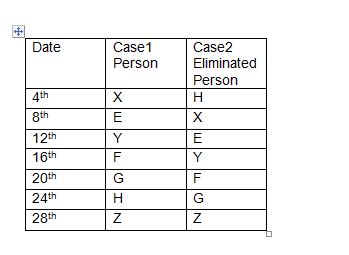
At most two people celebrated their birthday after G. Neither F nor G celebrated their birthday on 28th of the month. The difference between the days of G and E to celebrate their birthday is 12. X celebrated his birthday immediately before E. No one celebrated their birthday between Y and F, who celebrated his birthday after Y. Z celebrated his birthday after H, who doesn’t celebrate his birthday before X. From above statements, Case-1 : Here G and E celebrated their birthday on 20th and 8th of the month respectively. X celebrated his birthday on 4th of the month. Y and F celebrated their birthday on 12th and 16th of the month respectively. Finally, H and Z celebrated their birthday on 24th and 28th of the month respectively. Thus all the given condition gets satisfied and we get the completed arrangement in Case- Case-2: Here G and E celebrated their birthday on 24th and 12th of the month respectively. X celebrated his birthday on 8th of the month. Y and F celebrated their birthday on 16th and 20th of the month respectively. As per last reference point, H doesn’t celebrate his birthday before X. Thus there is no other date left for H. Thus this case-2 becomes invalid and it can be eliminated.
'A' invests Rs.10,000 for 3 years at a certain rate of interest. At the end of the second year, it amounts to Rs.11,664. Calculate the rate of interest ...
What will be the amount payable on Maturity of ₹2,250 invested for three years 20% p.a. interest compounded yearly?
A sum of ₹33,100 was divided between Timir and Monali in such a way that if both invested their shares at 10% compound interest per annum, the amount ...
A sum of money amounts to Rs 1024 in 4 years and Rs 1458 in 7 years at a compound rate of interest. What is the rate of interest per annum?
The difference between the compound interest and simple interest on a certain sum for 2 years at 12% per annum is 144. Find the principal amount.
The simple interest on a sum of money will be Rs. 800 after 10 years. If the principal is tripled after 5 years, what will be total interest at the end ...
Two trains start from points A and B, 300 km apart, and travel towards each other. Train 1 starts from A at 60 km/h, while Train 2 starts from B at 40 k...
The compound interest on a certain sum for 2 years at 10% per annum is Rs. (x+420). The simple interest on the same sum at the same rate for the same ti...
A sum of money amounts to ₹12,960 in 2 years at compound interest. If the rate of interest is 10% per annum, what is the principal amount?
What is the compound interest in a sum of 7500 for 12/5 years at 20% p.a., interest compounded yearly (nearest to an integer)?
