


Question
Who lives on 4TH floor?
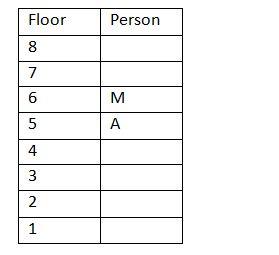 3. Only two persons live between M and B. 4. E live above B but not at the topmost floor.
 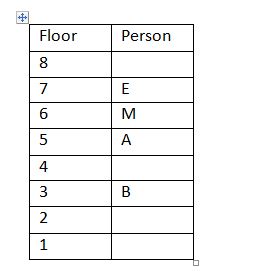 Note: E live on 7th floor not on 4th floor because no two persons according to alphabetical order live adjacent to each other. 5. Only one person sit between Z and B. 6. N live either 2nd or 7th floor.
 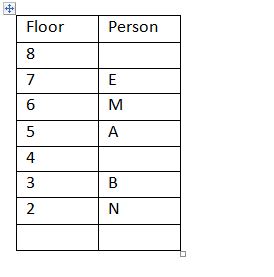 F cannot sit on topmost floor because no two persons according to alphabetical order live adjacent to each other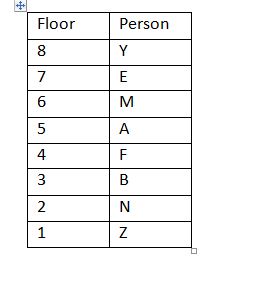
More Puzzles Questions
- How much salary D gets?
- On which of the following days Vaani was born?
- Who auctioned just before the one who has Ford?
- Which of the following book have thickness equal to 66mm thickness?
- Who likes Blue?
- Who among of the following lives on floor no 3?
- How many floors are there between O and person who likes Blue?
- Who among the following likes Zoology?
- Six persons D, E, F, M, N and O live in a six storey building but not necessarily in the same order. The bottommost floor is numbered as 1st and the topmos...
- Who among the following person completed the training in 2018?
Relevant for Exams:
Hey! Ask a query
Please enter email id
The email must be a valid email address.
Please enter Mobile Number
Please enter valid Mobile Number
Please enter your Doubt

Think You're Ready for RBI Grade B?
RBI Grade B 2026 Phase 1 Memory Based Paper
- 200 Questions with Detailed Solutions
- Section-wise Coverage (GA, English, Quant & Reasoning)