


Question
Who among the following live on the Even floor?
Who among the following live on the Even floor?
I. O
II. K
III. L
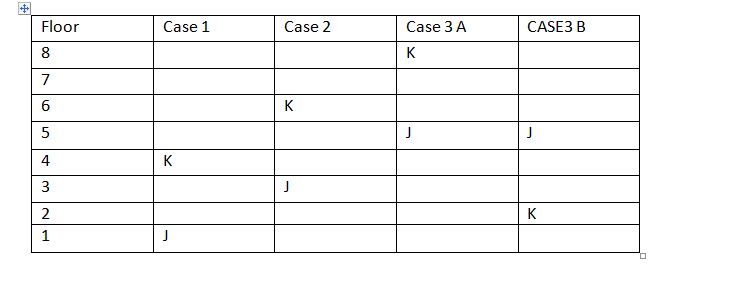 3. There is only one person live between K and M, who live just below N. 4. The number of persons living between O and L is same as the number of person living between O and M.
 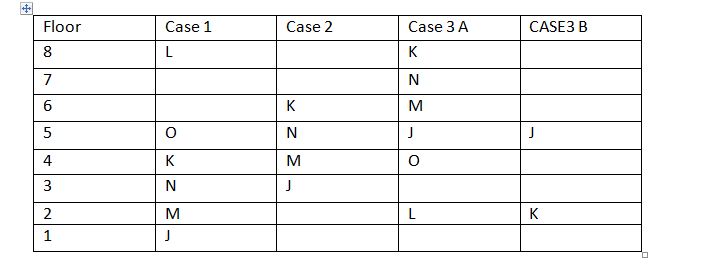 There is no floor empty for N in CASE3B So, CASE3B is cancelled out. There is no floor empty for O in CASE2 So, CASE2 is cancelled out. 5. L live on of the floor below O. 6. P lives on one of the odd floor but not at bottom most floor. So, CASE1is cancelled out.
 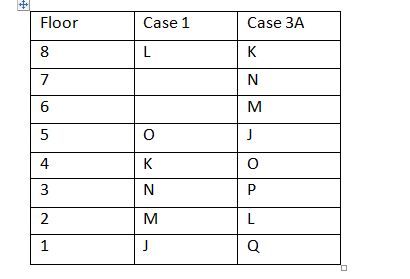 Final arrangement: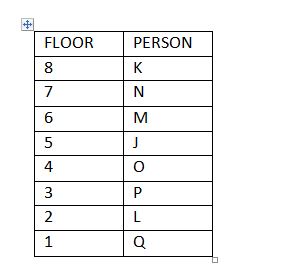
More Puzzles Questions
- Four of the following forms a group based on certain pattern. Who does not belong to this group?
- Person-M uses which of the following laptop?
- Seven different coloured books are kept one after the other. i. The RED book is just on the top of the ORANGE book. ii. The BLUE book is between the GREEN ...
- Who belongs to America?
- ________ is at the bottommost position?
- Who among of the following lives to the East of the one who speaks Hindi?
- Who among the following lives on floor 2?
- Combination of ages of which pair is maximum?
- If O is related to N and Q is related to M, then who among the following person is related to S?
- How many persons are there between Sohan and the one who likes Biology?
Relevant for Exams:
Hey! Ask a query
Please enter email id
The email must be a valid email address.
Please enter Mobile Number
Please enter valid Mobile Number
Please enter your Doubt

Think You're Ready for RBI Grade B?
RBI Grade B 2026 Phase 1 Memory Based Paper
- 200 Questions with Detailed Solutions
- Section-wise Coverage (GA, English, Quant & Reasoning)