


Question
The question given below consists of two statements I and II given below it. You have to decide whether the data provided in the statements are sufficient to answer the question. Read all the statements and give answer. Eight persons A, B, C, D, E, F, G and H sit along a square shaped table. One person sits along each corner of the table and one person sits along the middle of each side of the table. The persons, who sit along the corner of the table face away from the centre and the persons, who sit along the middle of the side of the table face towards the centre. How many persons sit between C and D, when counted from the right of D? Statement I: A sits opposite to H. D sits immediate right of H. H does not sit along the middle of the side of the table. B sits third to the right of E. F, who sits along a corner, is adjacent to
The question given below consists of two statements I and II given below it. You have to decide whether the data provided in the statements are sufficient to answer the question. Read all the statements and give answer. Eight persons A, B, C, D, E, F, G and H sit along a square shaped table. One person sits along each corner of the table and one person sits along the middle of each side of the table. The persons, who sit along the corner of the table face away from the centre and the persons, who sit along the middle of the side of the table face towards the centre. How many persons sit between C and D, when counted from the right of D? Statement I: A sits opposite to H. D sits immediate right of H. H does not sit along the middle of the side of the table. B sits third to the right of E. F, who sits along a corner, is adjacent to
B. G does not sit adjacent to H. Statement II: D sits second to the right of G. H, who sits immediate right of D, does not sit along the middle of a side of the table. E sits opposite to F. C sits second to the left of
B. E does not sit adjacent to
C.
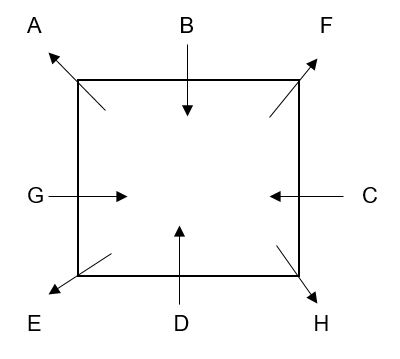 So, only one person sits between C and D, when counted from the right of D. So, data given in statement I alone is sufficient to answer the question. From statement II alone, D sits second to the right of G. H, who sits immediate right of D, does not sit along the middle of a side of the table. E sits opposite to F. C sits second to the left of B. E does not sit adjacent to C. We get:
More Data Sufficiency Questions
- The question given below consists of three statements numbered I, II and III given below it. You have to decide whether the data provided in the statements...
- Six persons A, B, C, D, T and U have different marks in a class test. Who has 2nd highest marks? Statement I: C has more marks than D and T. At least two p...
- How many persons are sitting in the row (assuming all are facing north)? Statement I: Sanjiv sits 5th from the right end of the row. Rinku sits 11th from t...
- Seven persons, L, M, N, O, P, Q and R goes for vacation in seven different months among January, February, March, April, May, June and July of the same yea...
- J, K, L, M and N are sitting around a circular table, facing the centre. Who is on the immediate left of L? I. J sits between K and N. L is on the immedia...
- Seven persons A, B, C, D, E, F and G are sitting in a row facing north but not necessarily in the same order. Which of the following persons sit fourth to ...
- The question given below consists of two statements numbered I and II given below it. You have to decide whether the data provided in the statements are su...
- How is B related to C? I. C and D are the sons of E. B is son of E’s father. II. E is sister of B and mother of D, who is brother of C.
- Among Q, R, S, T , U and V, who earns the highest salary? I. T earns more than U but less than at least two persons, Q earns more than T but less than R. ...
- How is R related to Q? I. A is wife of one of the sons of T and mother of Q who is grandson of R. II. R is mother of Y. Y is father of Q but Q is not daugh...
Relevant for Exams:
Hey! Ask a query
Please enter email id
The email must be a valid email address.
Please enter Mobile Number
Please enter valid Mobile Number
Please enter your Doubt

Think You're Ready for RBI Grade B?
RBI Grade B 2026 Phase 1 Memory Based Paper
- 200 Questions with Detailed Solutions
- Section-wise Coverage (GA, English, Quant & Reasoning)