


Question
The question given below consists of three statements numbered I, II and III given below it. You have to decide whether the data provided in the statements are sufficient to answer the question. Read all the statements and give answer. Six persons A, B, C, D, E and F are sitting around a circular table facing centre. Who among the following sits immediate right of D?
The question given below consists of three statements numbered I, II and III given below it. You have to decide whether the data provided in the statements are sufficient to answer the question. Read all the statements and give answer. Six persons A, B, C, D, E and F are sitting around a circular table facing centre. Who among the following sits immediate right of D?
I. A sits second to the right of
D. C is adjacent to
A.
II. F and E are adjacent to each other. B is adjacent to F.
III. B sits to the immediate right of F, who is not adjacent to E. F and D are not opposite to each other.
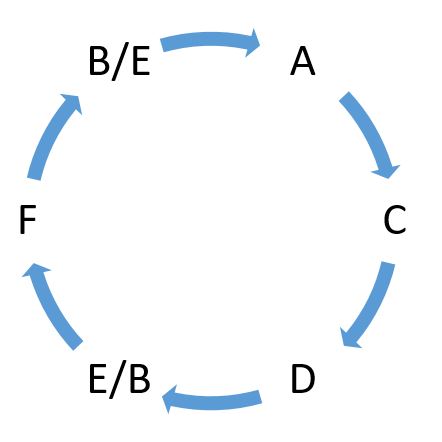 So, E is sitting immediate right of D. By combining statement I and III, A sits second to the right of D. C is adjacent to A. B sits immediate right of F, who is not adjacent to E. F and D are not opposite to each other. The arrangement is shown below,
 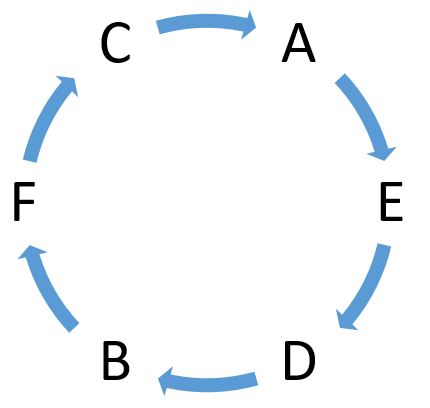 So, E sits immediate right of D. Therefore, statement I and II or I and III together are necessary to answer the question.
More Data Sufficiency Questions
- Who amongst A, B, C, D and E is the second tallest? I.A is shorter than B, E is not the shortest. II.C is shorter than A, D is not the shortest.
- Statements: M = U, U = V, V < W Conclusion: I. W > M II. W = U
- The question given below consists of three statements numbered I, II and III below them. You have to decide whether the data provided in the statements are...
- The question given below consists of three statements numbered I, II and III below them. You have to decide whether the data provided in the statements are...
- In which direction is point E with respect to G? Statements: I. F is in the north of G and E is in the west of F. II. H is in west of G and E is in the Nor...
- The question given below consists of two statements numbered I and II given below it. You have to decide whether the data provided in the statements are su...
- How is LETTER written in the code language? I. MASTER is written as NZHGVI II. BOTTLE is written as YLGGOV
- Six friends J, K, L, M ,N and O are sitting around a circular table facing the center. Who sits second to the left of N? I. K and O sit opposite each othe...
- The question given below consists of three statements numbered I, II and III given below it. You have to decide whether the data provided in the statements...
- A question is given, followed by two statements numbered (I) and (II). You have to decide whether the data provided in the statements is sufficient to answ...
Relevant for Exams:
Hey! Ask a query
Please enter email id
The email must be a valid email address.
Please enter Mobile Number
Please enter valid Mobile Number
Please enter your Doubt

Think You're Ready for RBI Grade B?
RBI Grade B 2026 Phase 1 Memory Based Paper
- 200 Questions with Detailed Solutions
- Section-wise Coverage (GA, English, Quant & Reasoning)