


Question
Given below is a question followed by two statements I and II. Read both the statements carefully to decide which one of them is sufficient to answer the question. Six people - D, E, F, G, H and I are sitting around a circular table facing the centre. Who sits to the immediate right of D? (
- I D sits third to the left of E. Only one person sits between D and F. I sits to the immediate left of F. (I
- I D sits second to the right of H. Only two people sit between D and E. G sits second to the left of I.
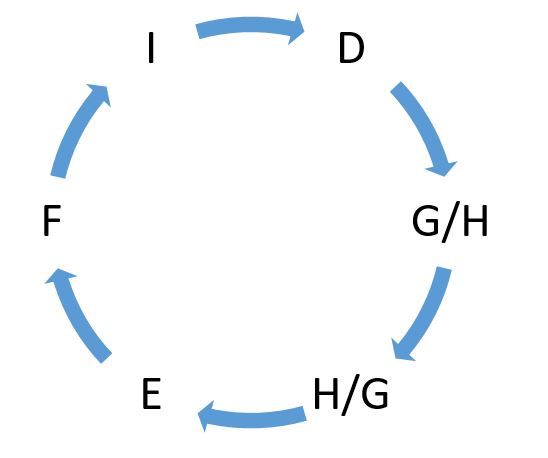 I is sitting immediate right of D. Hence data in Statement I sufficient to answer the question. From II.
 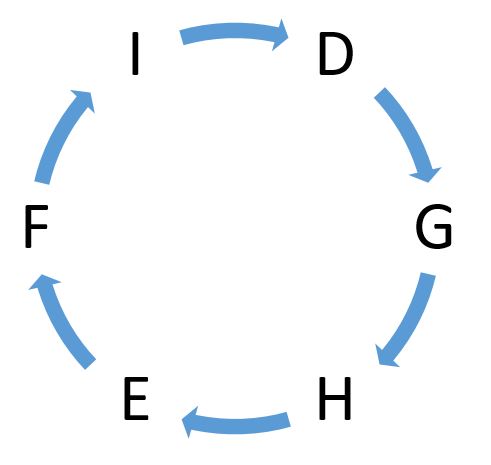 I is sitting immediate right of D. Hence data in Statement II sufficient to answer the question. Hence either data in statement I or statement II is sufficient to answer the question.
More Data Sufficiency Questions
- The question given below consists of two statements numbered I and II given below it. You have to decide whether the data provided in the statements are su...
- How is A related to B? I. C has two daughters and D is one of them who is married to A. II. C is mother of B, who is younger sister of D.
- Six persons P, Q, R, S, T and U have different heights. Who is the 4th shortest person? Statement I: Two persons are taller than P. R is not the tallest pe...
- Six persons F, G, H, I, J and K are sitting in a row facing north. Who among the following sits at the extreme left end? Statement I. K sits to the imme...
- Five persons L, N, O, P and Q, who all are of different weights. Who among the following is the lightest? Statement I: N is lighter than only one person. O...
- Seven players J, K, L, M, N, O, and P scored different runs in a match. At least three players scored more than 56 runs. Who scored the highest run? Statem...
- There are six persons P, Q, R, S, T and U are sitting on a circular table facing towards the centre. Who among the following sits to the immediate left of ...
- The question given below can be answered using sentence given in only one of the options. Find out the option which can be used to answer the question. E...
- In a row of 30 students facing north, what is Ankit’s position from the right end? I. Akash is fourth to the right of Ankit and 24th from the left end o...
- Eight boxes M, N, O, P, Q, R, S and T are kept one above the other, such that the bottommost box is numbered as 1, the box above it is numbered as 2 and so...
Relevant for Exams:
Hey! Ask a query
Please enter email id
The email must be a valid email address.
Please enter Mobile Number
Please enter valid Mobile Number
Please enter your Doubt

Think You're Ready for RBI Grade B?
RBI Grade B 2026 Phase 1 Memory Based Paper
- 200 Questions with Detailed Solutions
- Section-wise Coverage (GA, English, Quant & Reasoning)