


Question
A can do a piece of work in 24 days. B can do the same work in 16 days and C can do the same work in 5/4th time required by both A and B together. A and B work together for 6 days, then C complete the remaining work. How many day did C work?
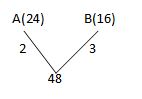 => (A + B) together = 48/5 day => C alone = (48/5) × (5/4) days = 12 days Remaining work = 48 – 5 × 6 = 18 C’s work = (18 × 12)/48 = 9/2 days
 More Time and work Questions
- ‘A’ alone can do some work in 10 days. ‘B’ and ‘C’ together can do the same work in 4 days. If ‘B’ is half as efficient as ‘A’, then find the time taken by...
- A and B can finish a task together in '2t' days. B alone can complete the task in 10 days, while A alone can do it in '5t' days. Find the value of 't'.
- A and B together can complete a work in 6 days, B and C together in 8 days, and C and A together in 12 days. In how many days can each of them complete the...
- John does ½ piece of work in 3 hours, Joe does ¼ of the remaining work in 1 hour and George finishes remaining work in 5 hours. How long would it have tak...
- A alone can finish a piece of work in 10 days, and B alone can finish it in 15 days. In how many days can they finish it together?
- 10 girls can finish a task in 8 days, while 5 women can finish the same task in 4 days. In how many days will 4 girls and 1 woman together finish the task?
- 36 workers are digging a tunnel 5 km long. After working for 20 days, only 2/3 of the tunnel is completed. Then 4 more workers join the team. How many days...
- ‘N’ men can complete a work together in 24 days. All of them started the work together, but each day, four men left the work. The total time taken to compl...
- A alone can complete 60% of a work in 36 days while B takes 30 days more than A to complete it. If B and C together can complete the work in 40 days, then ...
- A 480-liter blend contains soap and water in a 5:3 ratio. Adding 60 liters of soap and (6u + 30) liters of water changes the ratio to 6:5. Find the ratio o...
Relevant for Exams:
Hey! Ask a query
Please enter email id
The email must be a valid email address.
Please enter Mobile Number
Please enter valid Mobile Number
Please enter your Doubt

Think You're Ready for RBI Grade B?
RBI Grade B 2026 Phase 1 Memory Based Paper
- 200 Questions with Detailed Solutions
- Section-wise Coverage (GA, English, Quant & Reasoning)