


Question
Find the ratio of the number of Cello water bottles sold by shop D to the total number of Milton water bottles sold by shop
Find the ratio of the number of Cello water bottles sold by shop D to the total number of Milton water bottles sold by shop
A.
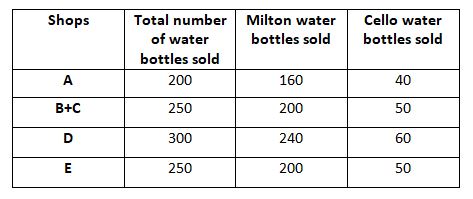 Required ratio = 60: 160 = 3:8
More DI Questions
- What is the ratio between numbers of automatic cars sold to manual cars sold in city B?
- The AC in the Store B is approximately what percent of the Refrigerators in the Store F?
- What is the average number of people who read only TOI, The Hindu and Economic Times only and all three newspaper?
- On April, if 5% of total cars available for sell remain unsold, then find the ratio of total number of cars available for sell on August to that on April.
- What is the difference between the number of Umbrella sold in city B and the number of Raincoat sold in city A?
- If the number of butter cookies baked on Wednesday are increased by 5/16 and there are two types of butter cookies baked on Wednesday (chocolate and vanill...
- If 40% women and 60% children went to cinema hall E for the first time, then find the total number of women and children who visited cinema hall E for the ...
- The table below shows the number of students in different streams of a college: Find the ratio of Arts students to non-Arts students.
- Find the difference between the number of Oranges sold by E and number of Apples sold by B.
- What is the difference between the number of girls playing Volleyball and Baseball?
Hey! Ask a query
Please enter email id
The email must be a valid email address.
Please enter Mobile Number
Please enter valid Mobile Number
Please enter your Doubt

Think You're Ready for RBI Grade B?
RBI Grade B 2026 Phase 1 Memory Based Paper
- 200 Questions with Detailed Solutions
- Section-wise Coverage (GA, English, Quant & Reasoning)