


Question
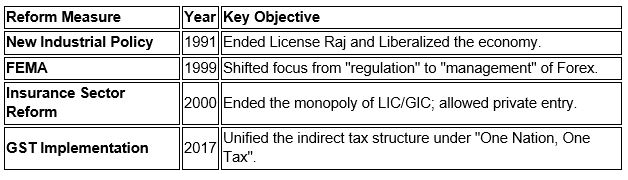
Arrange the following economic reforms in India in the correct chronological order of their introduction (from the earliest to the latest): Enactment of the Foreign Exchange Management Act (FEM
- A . Introduction of the Goods and Services Tax (GS
- T . Abolition of Industrial Licensing for most industries (New Industrial Policy). Opening of the Insurance sector to private and foreign players.
More Research Questions
- If coefficient of correlation rxy= 1, then
- Demonetization refers to
- If rxy = 0.75, then ryx will be:
- Question 4
- Comparative statics in mathematics/economics refers to:
- Which of the following deficits indicates the true current fiscal position of the Indian Economy?
- According to the Quantity Theory of Money (QTM), what is the predicted effect of a change in the velocity of money on the price level in the long run?
- Based on the Economic Survey 2025-26, what was the status of Scheduled Commercial Banks' (SCBs) asset quality as of September 2025?
- If the regression coefficients of x on y and y on x are -1/4 and -1/9 respectively, then what is the correlation coefficient between x and y?
- lumpsum tax is levied on the monopolist, the burden will be borne by
Hey! Ask a query
Please enter email id
The email must be a valid email address.
Please enter Mobile Number
Please enter valid Mobile Number
Please enter your Doubt

Think You're Ready for RBI Grade B?
RBI Grade B 2026 Phase 1 Memory Based Paper
- 200 Questions with Detailed Solutions
- Section-wise Coverage (GA, English, Quant & Reasoning)