


Question
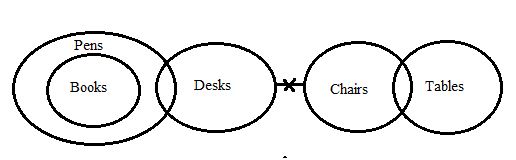
Statement : All books are pens. Some pens are desks. No desk is a chair. Some chairs are tables. Conclusion: Some chairs are not pens. Some tables may be desks. Some desks may not be pens. No book is desk. .
More Syllogism Questions
- Statements: Some couliflower are cabbage. Some cabbage are asparagus. Some asparagus are pumpkin. Conclusions: I. No couliflower is asparagus II. Some aspa...
- Statements: All districts are towns. No town is a city. All cities are centres. Conclusion: I. Some towns are districts. II. Some cities are not dist...
- Statements: Only Time is Hour. Some Times are Minutes. Mostly Minutes are Seconds. Conclusions: I. Some Hour cannot be Second II. Some Second is Hour
- Statements: Some font is marker. All marker is letter. No letter is design. Every design is review. Conclusions: I. Some design being marker is a possibili...
- Statements: Few Numbers are Letters. All Numbers are Consonants. Some Consonants are not Alphabets. Conclusion: I. No Number is Vowel. II. Some Conso...
- Read the given statements and conclusion carefully. Assuming the information given in the statement is true, even if it appears to be at variance with comm...
- Statement: Only a few P are Q Only a few Q are P Conclusion: I. All Q being P is a possibility. II. No P can be Q.
- Statements: Some doors are windows. All windows are beds. Some beds are pillows. All pillows are blankets. Conclusions: I. Some doors...
- Two statements are given followed by two conclusions numbered I and II. Assuming the statements to be true, even if they seem to be at variance with common...
- In each of the questions below are given three statements followed by two conclusions numbered I and II. You have to take the given statements to be true ...
Hey! Ask a query
Please enter email id
The email must be a valid email address.
Please enter Mobile Number
Please enter valid Mobile Number
Please enter your Doubt

Think You're Ready for RBI Grade B?
RBI Grade B 2026 Phase 1 Memory Based Paper
- 200 Questions with Detailed Solutions
- Section-wise Coverage (GA, English, Quant & Reasoning)