


Question
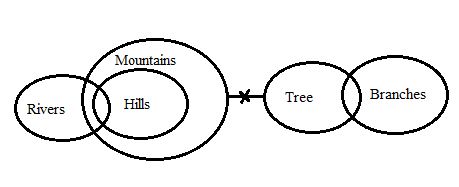
Statement : Some rivers are hills. All hills are mountains. No mountain is a tree. Some trees are branches. Conclusion : Some rivers are not trees. Some mountains are not branches. No tree is a hill. Some mountains are branches.
More Syllogism Questions
- Statements: No silver is a finger. All fingers are diamonds. Some diamonds are ring...
- In the question below there are three statements followed by two conclusions I and II. You have to take the three given statements to be true even if they ...
- Among P, Q, R, S and T whose salary is the highest? I. Combined salary of P and Q is more than the combined salary of R and S but T’s salary is more than ...
- Statements : All aeroplanes are helicopters. Some helicopters are kites. A...
- Statements: Only a few Twitter are Meta. Some Meta are Tiktok. No Tiktok is Instagram. Conclusions: I. Some Twitter are not Meta. II. Some Twitter are n...
- In the given question, two conclusions are given and five statements as 1), 2), 3), 4) and 5). You need to choose the option that contains the set of state...
- Three statements are given, followed by three conclusions numbered I, II and III. Assuming the statements to be true, even if they seem to be at variance w...
- Statement: Only a few Nation are States. Some States are Country. At least Country are Capital. Conclusion: Some Capital is Nation. No Nation is Capital.
- In the question below some statements are given followed by three conclusions I, II and III. You have to take the given statements to be true even if they ...
- Statements: Some Films are Pictures. Only a few Pictures are Movies. All Movies are Locations. Some Locations are not Theatres. Conclusions: I. Some Theatr...
Relevant for Exams:
Hey! Ask a query
Please enter email id
The email must be a valid email address.
Please enter Mobile Number
Please enter valid Mobile Number
Please enter your Doubt

Think You're Ready for RBI Grade B?
RBI Grade B 2026 Phase 1 Memory Based Paper
- 200 Questions with Detailed Solutions
- Section-wise Coverage (GA, English, Quant & Reasoning)