


Question
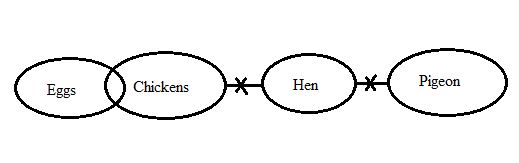
Statements : Some eggs are chickens. No chicken is a hen. No hen is a pigeon. Conclusions :
Statements : Some eggs are chickens. No chicken is a hen. No hen is a pigeon. Conclusions :
I. Some eggs may be hens.
II. Some chickens are not pigeons.
More Syllogism Questions
- Statement: Only a few A are B Some B are C No A is C Conclusion: I. Some A are not B II. Some A...
- In the question below some statements are given followed by three conclusions I, II and III. You have to take the given statements to be true even if they ...
- Statements:All Months are Years.Only a few Years are Weeks.No Week is Day.Conclusions:I. All Months can be Weeks.II. Some Years are not Days.III. Some Days...
- In the question below some statements are given followed by three conclusions I, II and III. You have to take the given statements to be true even if they ...
- Statements: Some nails are toes. Some fingers are hands. No hand is a nail. Conclusions: I. Some fingers are not nails. II. All nails can be fingers.
- Statement: Each snickers are kit Kat. Only a few snickers are dairy milk. Few snickers are not munch. Conclusion: I. All kit Kat can be Munch. II. A...
- In the following questions below are given some statements followed by some conclusions based on those statements. Taking the given statements to be true e...
- In the questions given below, there are three statements followed by three conclusions I, II and III. You have to take the three given statements to be tru...
- In each question below are given two statements followed by two conclusions numbered I and II. You have to take the two given statements to be true even if...
- Statements: Some fabrics are silks. Some silks are cottons. Conclusions: I. At least some cottons are silks II. At least some fabrics are cotton
Hey! Ask a query
Please enter email id
The email must be a valid email address.
Please enter Mobile Number
Please enter valid Mobile Number
Please enter your Doubt

Think You're Ready for RBI Grade B?
RBI Grade B 2026 Phase 1 Memory Based Paper
- 200 Questions with Detailed Solutions
- Section-wise Coverage (GA, English, Quant & Reasoning)