


Question
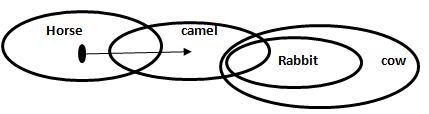
Statement: Only a few horses are camel. Mostly camel are rabbit. Each rabbit is cow. Conclusion: 1. All horse being camel is a possibility. 2. All camel being horse is a possibility.
More Statement and conclusions Questions
- Read the given statements and conclusions carefully. Assuming that the information given in the statements is true, even if it appears to be at variance wi...
- In the following question, a relationship between different elements is shown in the statement followed by two conclusions (I) and (II). Assuming the state...
- Statements: Only a few Rayon is Cotton. No Cotton is Muslin. Only a few Muslin is Modal. All Modal are Silk. Conclusions: I. Some Silk can be Muslin. II. S...
- Statement: Only a few horses are camel. Mostly camel are rabbit. Each rabbit is cow. Conclusion: 1. All horse being camel is a possibility. 2. All camel b...
- Three statements are given followed by three conclusions numbered I, II and III. Assuming the statements to be true, even if they seem to be at variance wi...
- Statement: Atleast some goa are Shimla. A few Shimla are Nainital. Only a few Delhi are Shimla. All Shimla are Agra. Conclusion: All Nainital be...
- In the question, assuming the given statements to be true, find which of the conclusion (s) among given two conclusions is /are definitely true, and then g...
- A situation is given, followed by two conclusions I and II. Read the situation and both the conclusions carefully and select the correct answer. Situation:...
- Statements: M @ N, P @ R, P & N Conclusions: a ) M @ P b) R & M
- Statements: S * K, T $ K, K @ B Conclusions: a) S $ B b) S @ B
Relevant for Exams:
Hey! Ask a query
Please enter email id
The email must be a valid email address.
Please enter Mobile Number
Please enter valid Mobile Number
Please enter your Doubt

Think You're Ready for RBI Grade B?
RBI Grade B 2026 Phase 1 Memory Based Paper
- 200 Questions with Detailed Solutions
- Section-wise Coverage (GA, English, Quant & Reasoning)