


Question
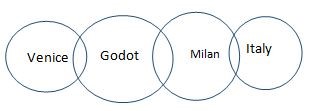
Statements: Some Venice are Godot. Some Milan are Godot. Some Italy are Milan. Conclusions:
Statements: Some Venice are Godot. Some Milan are Godot. Some Italy are Milan. Conclusions:
I. Some Venice are definitely Milan.
II. Some Italy being Godot is a possibility.
III. At least some Italy are Venice.
IV. All Godot being Venice is a possibility.
More Syllogism Questions
- In the question below some statements are given followed by three conclusions I, II, and III. You have to take the given statements to be true even if they...
- Statements: No mountain is plane. No river is mountain. Conclusions: I. No plane is river. II. All river are plane.
- Statements: A few gifts are surprises. Every surprise is cake. None of the cakes are balloons. Conclusions: I. A few gifts are not balloons. II. No balloon...
- Statements: Only a few Barber is Patient. No Patient is Teacher. Only a few Teacher is Doctor. Conclusion: I. All Doctor being Patient is a possibilit...
- Statements: Some racks are tables. Some tables are chairs. No chair is a book. Conclusions: ...
- Statements: Some guitars are harmoniums. No harmonium is a sitar. Conclusions: I. Some guitars are not sitars. II. Some sitars are not guita...
- Statements: All Bottles are Glasses. All Glasses are Bowls. Some Cups are Bowls. Conclusions: I. Some Cups are Glasses. II. All Bottles are Bowls. III. Som...
- In each of the questions below are given three statements followed by two conclusions numbered I and II. You have to take the given statements to be true ...
- Read the given statements and conclusions carefully. Assuming that the information given in the statements is true, even if it appears to be at variance wi...
- Statements: Only Digit is Number Some Digit are Word Some Word are Letter Conclusions: I. Some Number are Letter II. Some Digit are Letter III. No Number i...
Hey! Ask a query
Please enter email id
The email must be a valid email address.
Please enter Mobile Number
Please enter valid Mobile Number
Please enter your Doubt

Think You're Ready for RBI Grade B?
RBI Grade B 2026 Phase 1 Memory Based Paper
- 200 Questions with Detailed Solutions
- Section-wise Coverage (GA, English, Quant & Reasoning)