


Question
Who among the following sits opposite to O?
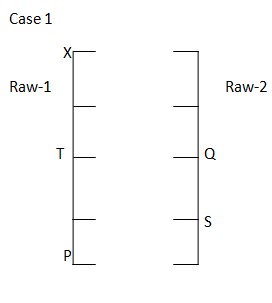
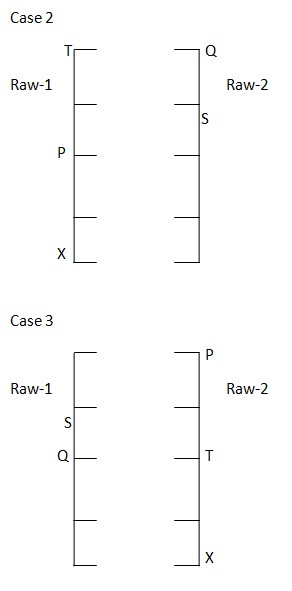
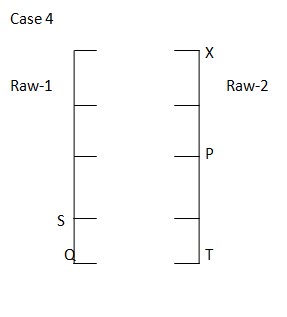 U sits second to the left of Q and is sitting adjacent to the one who faces R. T is not sitting adjacent to R. case I and III are invalid as R and T are not sitting together.
 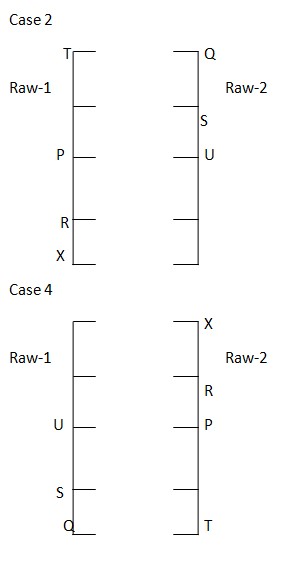 Neither O nor V sits at the extreme ends. V neither faces west nor sits adjacent to U. case IV is rejected as we can’t fix V in case IV. The final arrangement is as follows: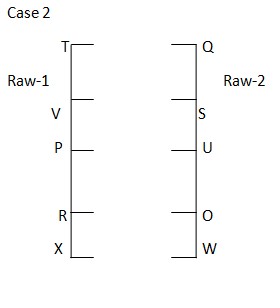
More Seating Arrangement Questions
- Who among the following person sits second to the left of V?
- Five friends B, C, D, E and F are sitting in a straight line all facing in the north direction. B is sitting at one of the extreme ends. Three people are s...
- There are six persons F, G, H, I, J and K sitting around the circular table facing towards the centre. F sits second to the right of H. One person sit betw...
- Which of the following pairs represent the people sitting at extreme end of the rows?
- Six persons, L, N, P, R, T, V, sit along a linear row and face in the north direction. N sits second to the right of R. Two persons sit between N and T. V ...
- What is the position of F with respect to H?
- X likes which of the following Actor?
- Statements: M < N = C; Q ≥ N > R; U ≤ Q < P Conclusions: I. Q ≥ M II. R < C
- Who is preparing for UPSC?
- Who among the following sits 3rd to the right of the one who likes pink?
Relevant for Exams:
Hey! Ask a query
Please enter email id
The email must be a valid email address.
Please enter Mobile Number
Please enter valid Mobile Number
Please enter your Doubt

Think You're Ready for RBI Grade B?
RBI Grade B 2026 Phase 1 Memory Based Paper
- 200 Questions with Detailed Solutions
- Section-wise Coverage (GA, English, Quant & Reasoning)