
Question
Who among the following persons sits on the left end of
both rows? Study the following information carefully to answer the given questions:- There are ten family members A, B, C, D, E, F, G, H, I, J. They work different banks i.e. PNB, SBI, BOI, HDFC, BOM, UCO, YES, ICICI, IDFC and RBI but not necessarily in the same the same order. They are sitting in two parallel rows containing five members each, in such a way that there is an equal distance between adjacent persons. In row 1 – A, B, C, D, E are seated (not necessarily in the same order) and all of them are facing south. In row 2- F, G, H, I, J are seated (not necessarily in the same order) and all of them are facing north. Members of row 1 are sitting ahead (towards north) of the members of row 2. Therefore in the given seating arrangement each member seated in row 2 faces the back of the other member of row 1. All of them have relation with each other. Only one member sits between C’s sister and A’s brother. Only two members sit between C’s father and I’s father. Neither B nor I’s grandfather sits just opposite to I. G work HDFC and B work neither PNB nor RBI. I’s husband, who work UCO, sits third to the right of I’s uncle. F sits second to the left of I’s husband. A has two sons and one daughter. The member who sits just opposite to I’s brother, who work BOI, sits immediate left of A’s daughter. E is the grandmother of F and I. D is the brother – in – law of E. C is the father of F and brother of B. F’s grandfather, who work PNB, is not an immediate neighbour of B. J is the husband of I and brother of the one, who work BOM. I work YES and E work IDFC. C work neither ICICI nor SBI. H work BOM. D does not work SBISolution
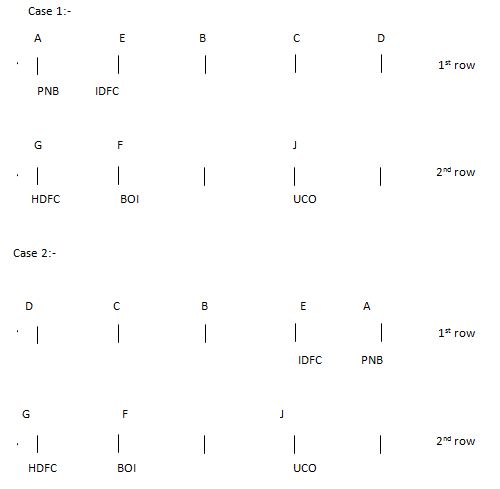
Only one member sits between C’s sister and A’s brother. Only two members sit between C’s father and I’s father. I’s husband, who work UCO, sits third to the right of I’s uncle. F sits second to the left of I’s husband. The member who sits just opposite to I’s brother, who work BOI, sits immediate left of A’s daughter. F’s grandfather, who work PNB, is not an immediate neighbour of B. I work YES and E work IDFC. From these conditions there will be two cases:- Â
A and B started a retail store with initial investments in the ratio 5:6 and their annual profits were in the ratio 2:3. If A invested the money for 8 m...
If the ratio of time periods of investment of A and B is 3:5, profit at the end of the year is Rs.120000 and A’s share in it is Rs.20000, then what is...
- ‘X’ started a business by investing Rs. 2,000. After 3 months, ‘Y’ joined with 50% of X’s investment. If the annual profit is Rs. 6,600, find the...
Rs. ‘y’ was invested in scheme A at the rate of 21% per annum for (t+2) years. Rs. (y+2400) was invested in scheme B at the rate of 18% per annum fo...
A invested Rs. (P + 1200). After 3 months, B joined with Rs. 3P. If B’s share to A’s share of the annual profit is 9:5, determine (P − 600).
...X, Y, and Z each invested amounts of Rs. 60,000, Rs. 180,000, and Rs. 100,000 at an annual simple interest rate of 5%. The investment durations for X, Y...
A and B enter into partnership. A invests some money at beginning, B invests thrice the amount after 4 months and C invests double the amount after 9 mo...
A started a business with an investment of Rs.30000. After few months B joined him with an investment of Rs.42000. If at the end of the year, they share...
Raj invested Rs.32000 in a business. After 7 months, Rohan joins him with an investment of Rs.P. If at the end of the year the profit is Rs.55000 and pr...
'A' and 'B' started a partnership by investing Rs. 9,000 and Rs. 12,000 respectively. 25% of the total profit is given to 'A' for managing the business,...
