


Question
Who amongst the following likes Pink?
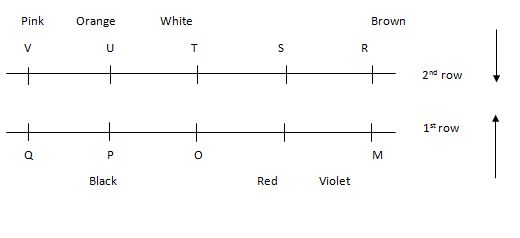 (2) When V sits extreme right end of the row V faces one of the immediate neighbours of the one who likes Black. Only two people sit between M and the one who likes Black. M faces the one who likes Brown. P is an immediate neighbour of Q. So only two places left for P and Q. so U can be either at 2nd or 3rd to the left end of the 2nd row. Now we know that S is not an immediate neighbour of U and faces the one who likes Red. U does not like Brown. S does not sit at the extreme end of the line. It means S sits 2nd to the right end of the 2nd row. So U sits 2nd to the left end of the 2nd row. U faces immediate neighbours of Q. so Q sits right end of the 1st row. R faces the one who likes Violet. R does not like White. So R sits right end of the row and T sits at the centre of the row. The one who likes Pink sits to the immediate right of the person who likes Orange. V does not like Pink. The one who likes Green sits opposite to the person who sits left of the person who likes Pink. The one who likes Cream faces north.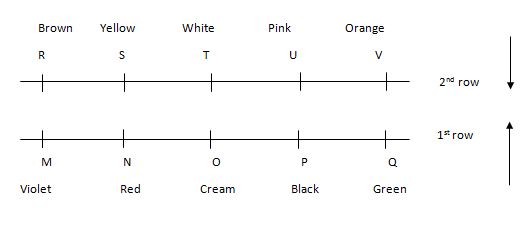
More Seating Arrangement Questions
- Eight friends, D, E, F, G, H, I, J and K, are watching a movie sitting in a line. H is sitting at one of the corners. E is sitting between K and F. J is si...
- Seven persons P, Q, R, S, T, U and V sit in a straight row facing north direction. R sits third to the left of P. Q sits adjacent to P. S sits second to th...
- How many of them earn more than Lalit?
- How many persons sit between K and P?
- Houses of six persons J, K, L, M, N and O are situated in two rows of three houses each sitting opposite to each other. M's house is diagonally opposite to...
- H likes which of the following colour?
- Who among the following faces L?
- Six persons D, E, F, G, H and I sit in a linear row such that each of them faces towards north direction. D sits third to the right of I. Neither D nor I s...
- Who sits opposite to F?
- Who sits third to the right of E?
Hey! Ask a query
Please enter email id
The email must be a valid email address.
Please enter Mobile Number
Please enter valid Mobile Number
Please enter your Doubt

Think You're Ready for RBI Grade B?
RBI Grade B 2026 Phase 1 Memory Based Paper
- 200 Questions with Detailed Solutions
- Section-wise Coverage (GA, English, Quant & Reasoning)