


Question
Which of the following statement is not true?
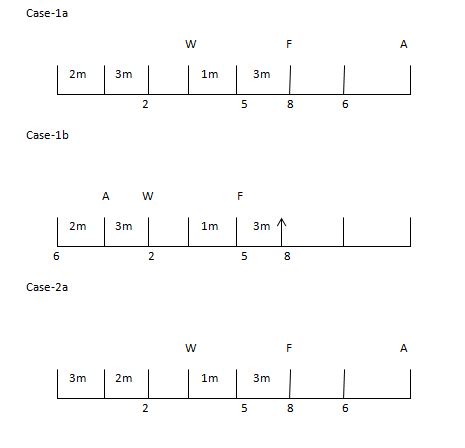
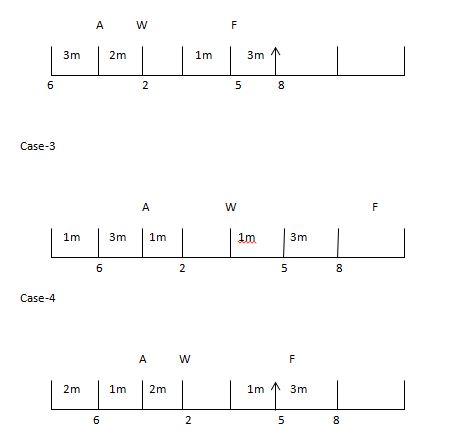 Again, we have: Z sits third to right of the one who likes 3, since none of the adjacent person likes consecutive numbers. Z neither sits adjacent to A nor likes even number, that means in case (1a), case (1b), case (2a) & case (2b) the one who likes 3 sits at right end facing south and case (3) & case (4) are not valid. The one who likes 4 sits 2m away from X. X sits 7m left of the one who likes 7, thus in case (1a) & case (1b) X sits at left end and W likes 7, in case (2b) X sits at right end and W sits facing south. Based on above given information we have: Case-1a
 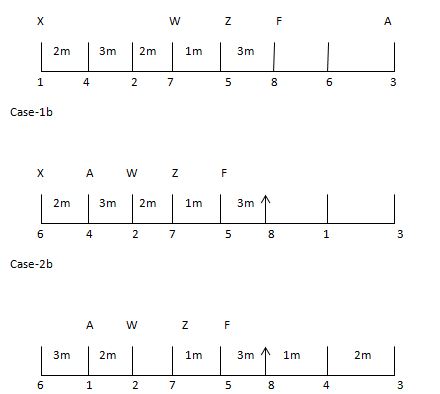 Case (3) & case (4) are not valid as Z sits third to right of the one who likes 3 and case (2a) is not valid as X sits 7m left of the one who likes 7. Again, we have: Y sits immediate right of the one who likes 1. J sits 8m left of E, who neither likes prime number nor sits adjacent to the one who likes 4, that means in case (1a) & case (1b) J sits third from left end and E sits facing north, case (2b) is not valid. Z sits 6m right of Y, that means distance between E and Y is 1m and case (1a) is not valid. Y and A sits facing in same direction but opposite to the direction of J, that means A sits facing south and J sits facing North. Based on above given information we have final arrangement as follow: Case (2b) is not valid as J sits 8m left of E and case (1a) is not valid as Z sits 7m right of Y. Case-1b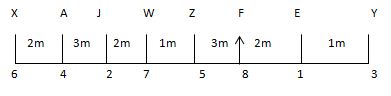
More Seating Arrangement Questions
- . Who is sitting to the immediate right of the person preparing for IBPS PO?
- Who amongst the following reads The Hindu?
- Six persons D, E, F, G, H and I sit in a linear row and face in the north direction. G sits at an extreme end of the row. Only two persons sit between G an...
- In which of the following statement, the first and second persons are sitting opposite to each other in the final arrangement? I) PW II) QT III) VW
- How many of them earn more than Lalit?
- Who is the spouse of A?
- Six persons S, T, U, V, W, and X in a linear row and face towards north direction (not necessarily in the same order). Only three persons sit between U and...
- In the questions given below, there are three statements followed by three conclusions I, II and III. You have to take the three given statements to be tru...
- Seven people P, Q, R, S, T, U and V are sitting in a straight line facing north. Only two people sit to the right of Q. Only two people sit between Q and P...
- Who sits third to the left of Ketan?
Relevant for Exams:
Hey! Ask a query
Please enter email id
The email must be a valid email address.
Please enter Mobile Number
Please enter valid Mobile Number
Please enter your Doubt

Think You're Ready for RBI Grade B?
RBI Grade B 2026 Phase 1 Memory Based Paper
- 200 Questions with Detailed Solutions
- Section-wise Coverage (GA, English, Quant & Reasoning)