


Question
How many persons are living below the one who likes RED?
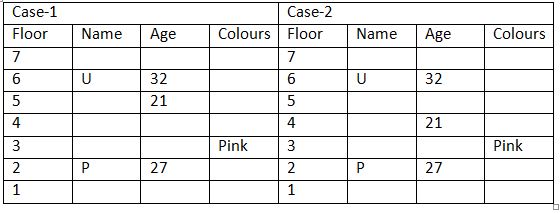 The age of R is 3/4th of the ages of the one who likes Yellow. Since, only such possible combination is (28, 21). A person living just above R lives two floors away from the one who likes Yellow. That means, in case (1) the one who likes Yellow lives on the floor marked 4, in case (2) the one who likes Yellow lives on the floor marked 7. Two persons are living between the one who likes Blue and T, who likes White. The number of persons living below T is one less than the number of persons living above the one who likes Black. Sum of ages of T and the one who likes Pink is twice the ages of Q. Ages of Q is neither an odd number nor likes Yellow. Since, the only possible combination is (23, 29, 26). That means, in case (2b) T lives on the floor marked 1, case (1) & case (2a) are not valid. Based on the above given information we have:
 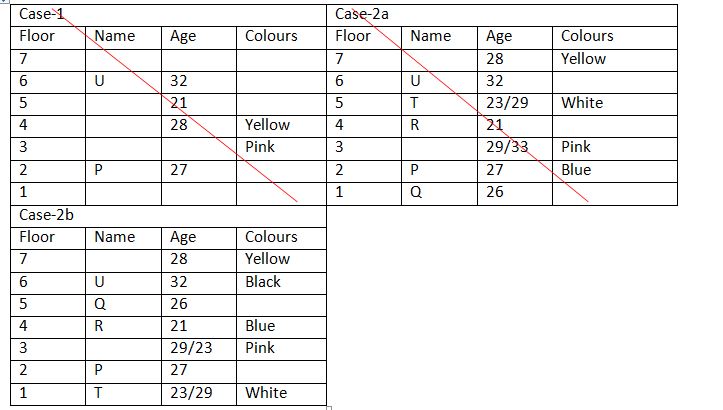 Case (1) & case (2a) are not valid as two persons are living between the one who likes Blue and T, who likes White. Again, we have: At least two persons are living between S and the one who likes RED. The one who likes RED lives just above the one whose age is 29 years. That means, S lives on the floor marked 7, and the age of T is 29 years. Based on the above given information we have the final arrangement as follows: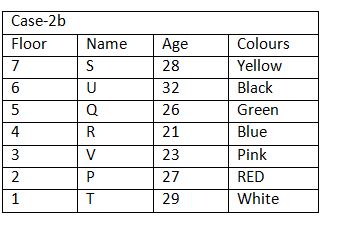
More Puzzles Questions
- Who lives in the same flat of T?
- Who among the following person doesn’t form a group?
- How many persons visits after the one who visits Afghanistan?
- Who lives on 4TH floor?
- Who lives to the East of the one who likes Orange?
- Firoj was in which of the following rows?
- On which of the following shelf number does Box G is kept from the top?
- If in a certain code language ‘deal work’ is coded as ‘ynr fik’, then which of the following is the code of ‘when talent school’?
- Who sits diagonally opposite the one who likes Orange?
- Which of the following statement is true regarding B?
Relevant for Exams:
Hey! Ask a query
Please enter email id
The email must be a valid email address.
Please enter Mobile Number
Please enter valid Mobile Number
Please enter your Doubt

Think You're Ready for RBI Grade B?
RBI Grade B 2026 Phase 1 Memory Based Paper
- 200 Questions with Detailed Solutions
- Section-wise Coverage (GA, English, Quant & Reasoning)