


Question
Which of the following statement is not true?
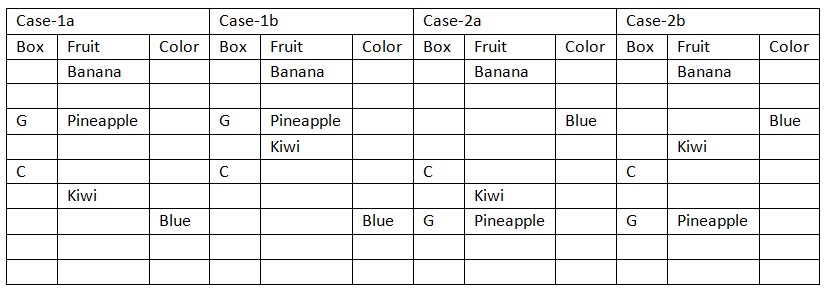 Box I, which is neither kept adjacent to box G nor one that contains Kiwi, is kept at a gap of three boxes from one that contains Apple. Box that contains Apple and Cherry are kept to gather Only four boxes are kept between one that contains Apple and one that is wrapped with Red paper, that means case (1b) and (2a) is not valid.
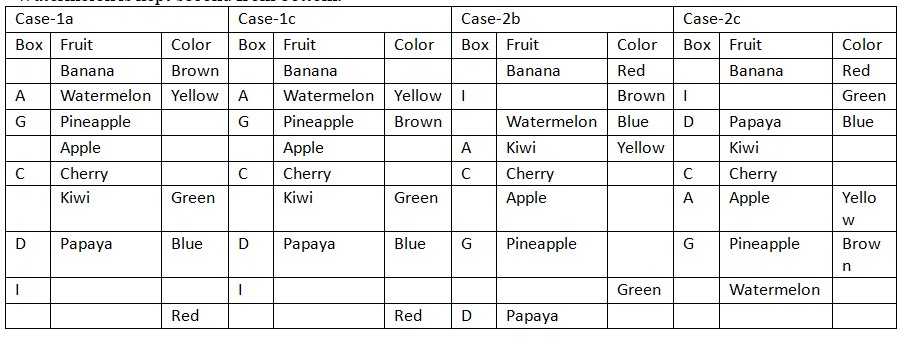
 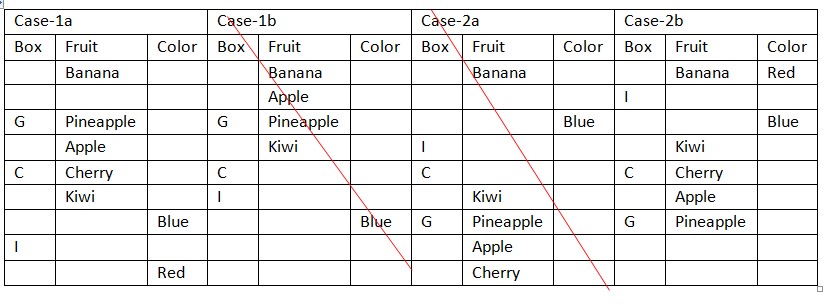 Case (1b) is not valid as box that contains Apple and Cherry are kept together and case (2b) is not valid as box that contains Apple and one wrapped with Red paper are kept at a gap of four boxes. Box A is wrapped with Yellow paper is kept at a gap of three box from one wrapped with Green paper. The box wrapped with Green paper is kept just above box D which contains Papaya, that means in case (1a) A is kept second from top, in case (2b) box A is kept fourth from top, in case (2c) box A is kept fourth from bottom. Box which contains Watermelon and one wrapped with Brown paper is kept together. Box that wrapped with brown paper is not kept at bottom. Box which contains Watermelon is neither kept adjacent to one contains Papaya nor kept at bottom, that means in case (1a) box wrapped with Brown is kept at top, in case (1c) box G is wrapped with Brown paper, in case (2b) box I is wrapped with Brown paper, in case (2c) box that contains Watermelon is kept second from bottom.
  Only two boxes are kept between one that contains Mango and box which is wrapped with Black paper. Box that contains Grapes kept just below one wrapped with White paper. Number of boxes between E and H is same as number of boxes between box F and one which wrapped with Orange paper. Box E, which is neither wrapped with Pink nor white paper, is kept at any place above box H, which is kept at a gap of one box from box B. Box which wrapped with Pink paper is kept at any place above box wrapped with Orange paper. Box F neither wrapped with Brown paper nor contains Kiwi, that means in case (1a) box F is kept at bottom, case (1c), (2b) and (2c) are not valid. Based on above given information we have final arrangement as follow:
 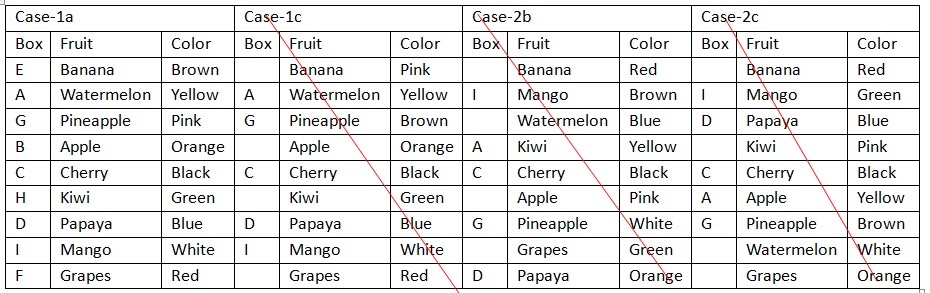 Case (1c), (2b) & (2c) is not true as number of boxes between E and H is same as number of boxes between box F and one which wrapped with Orange paper is not valid. So final arrangement is- Case-1a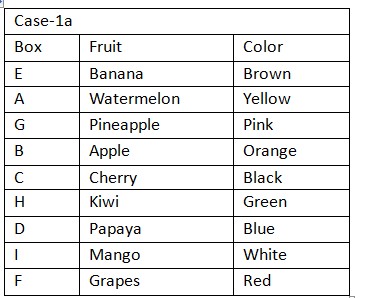
More Puzzles Questions
- Which of the following does not belong to the group?
- Which of the following is true regarding K?
- How many floors are there below the floor on which the one who likes Hockey lives?
- Which of the following statements is/ are true regarding H?
- What is the rank of M from the top as per given designation order?
- Who lives in the same flat of T?
- Which of the following students did not opt for Physics?
- Find the odd out of all the five?
- Which one of the following combinations of 'floor number - person - family members' is the correct one?
- __ lives to the south west of F
Relevant for Exams:
Hey! Ask a query
Please enter email id
The email must be a valid email address.
Please enter Mobile Number
Please enter valid Mobile Number
Please enter your Doubt

Think You're Ready for RBI Grade B?
RBI Grade B 2026 Phase 1 Memory Based Paper
- 200 Questions with Detailed Solutions
- Section-wise Coverage (GA, English, Quant & Reasoning)