


Question
Who among the following person gets into the lift on floor number two?
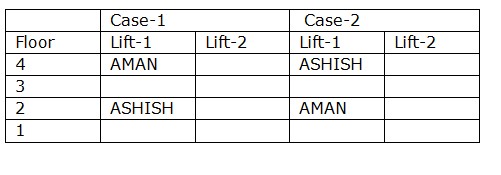 ARJUN is getting into the lift immediately above ASHWANI’s lift. Either ARJUN or ASHWANI is getting into the lift on the same floor of AMAN. From the above condition, there are three possibilities.
 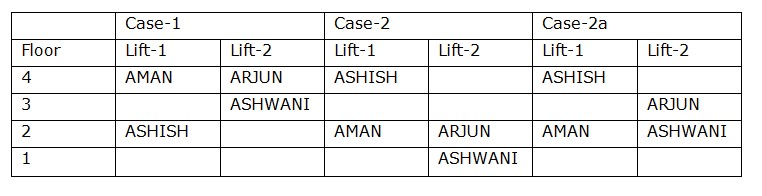 ASHOK does not get into the lift on an odd numbered floor. Both ARUN and ARYAN are using the same lift, ARYAN gets in above ARUN.
 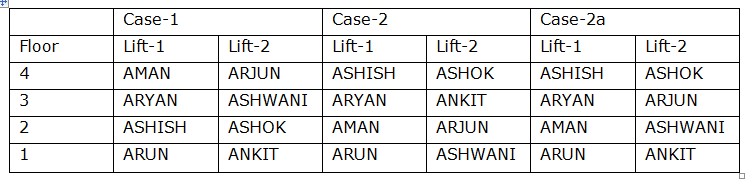 Neither ANKIT nor ARJUN using the lift on same floor of ARUN From the above condition, Case1 and case2a were dropped.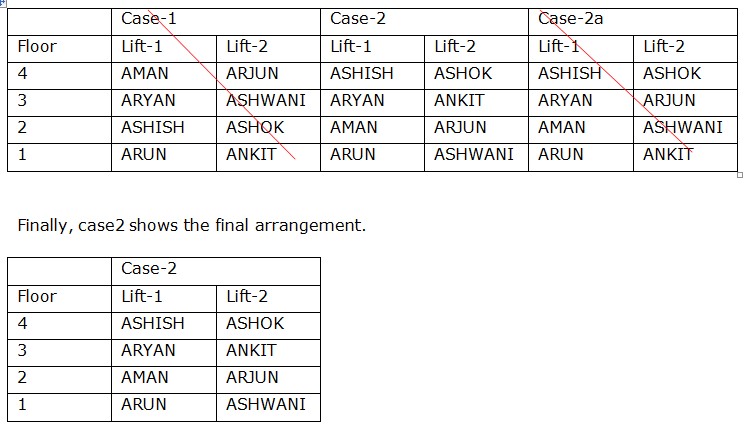
More Puzzles Questions
- On which floor does H live?
- If in a certain way ‘Red’ is related to ‘Banana’, Blue is related to ‘Grapes’ in the same way ‘Black’ is related to who among the following?
- Six persons (U, V, W, X, Y, and Z) live on different floors of a six-floor building. The bottommost floor is numbered as 1 and the topmost floor is numbere...
- Which of the following statement is true?
- Which of the following box has kept exactly in the middle of box B and box E?
- Seven boxes D, E, F, G, H, I and J are kept one above another. G is three boxes above I. There are two boxes between G and J. D is immediately above F. F i...
- Which combination represents D’s favourite colour and the subject?
- Which of the following combination of rooms are vacant?
- Which of the following statements is true about the one who likes Asha bhosle?
- Four of the following five are alike in a certain way and hence they form a group. Which one of the following does not belong to that group?
Hey! Ask a query
Please enter email id
The email must be a valid email address.
Please enter Mobile Number
Please enter valid Mobile Number
Please enter your Doubt

Think You're Ready for RBI Grade B?
RBI Grade B 2026 Phase 1 Memory Based Paper
- 200 Questions with Detailed Solutions
- Section-wise Coverage (GA, English, Quant & Reasoning)