


Question
Which among the following appears for the exam in month having more than 30 days?
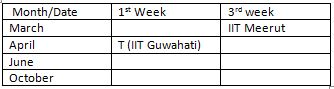 CASE-2
 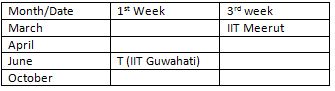 Only 4 persons can appear between the ones who are appearing for IIT Meerut and IIT Kanpur. 3 persons can appear for the test between T and U. Only 2 persons appear between Q and S. And S does not appear in April. (so, we get 2 possible sub cases for case 1). S appears for IIT Chennai. Case-1a
 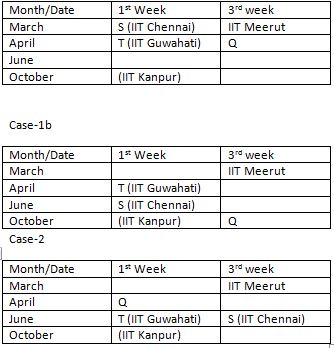 only 1 person appears for test of IIT Mumbai between R and W. (therefore, Case 1(a) and Case 1(b) gets eliminated as it does not satisfy the condition). W appears for the test of IIT Pune Only 3 persons appears between T and U Both Q and V appears on p same date. P appears for test of IIT Bangalore. One of the student appears for IIT Delhi.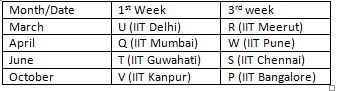
More Puzzles Questions
- On which floor does the person live who likes Nokia?
- How many floor between W and the one who likes REEBOK?
- How many persons stand between Q and V?
- How many Pink does Aaryan have?
- __ and __ live on same floor.
- Who among the following get highest annual salary?
- Which of the following is true with respect to V as per the given information?
- Seven persons, Shikha, Garima, Nidhi, Pooja, Manisha, Neena and Anu, lives in a 7-storey building, but not necessarily in the same order. The bottommost fl...
- What is the weight of the Pink box?
- If A is related Levis, C is related to Fila Shoes, in the same way E is related to which of the following?
Relevant for Exams:
Hey! Ask a query
Please enter email id
The email must be a valid email address.
Please enter Mobile Number
Please enter valid Mobile Number
Please enter your Doubt

Think You're Ready for RBI Grade B?
RBI Grade B 2026 Phase 1 Memory Based Paper
- 200 Questions with Detailed Solutions
- Section-wise Coverage (GA, English, Quant & Reasoning)