


Question
How many students appeared for SBI SO exam?
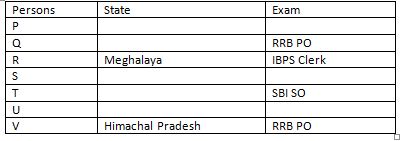 U and the person who belongs to Himachal Pradesh appeared for same exam. Therefore, U appeared for RRB PO. The person who belongs to Haryana appeared for RRB PO. The person who belongs to Punjab appeared for IBPS Clerk. S neither belongs to Haryana nor Madhya Pradesh. So, S belongs to Assam. T does not belong to Bihar. Therefore U belongs to Bihar. Final table
More Puzzles Questions
- Kajal is working in which company?
- Who among the following is second oldest?
- I has __ pens less than the ___.
- Which one of the following combination is true?
- Who celebrated his birthday between Y and G?
- Six persons (F, G, H, I, J, and K) live on different floors of a six-floor building. The bottommost floor is numbered as 1 and the topmost floor is numbere...
- Six persons R, S, T, U, V, and W live in a building of six-floors such that the bottommost floor is numbered as 1 and the topmost floor is numbered as 6 bu...
- Which of the following is true regarding H?
- Which of the following live just below E?
- If S is related to Social science and V is related to English in a certain way. Then, Q is related to which of the following?
Relevant for Exams:
Hey! Ask a query
Please enter email id
The email must be a valid email address.
Please enter Mobile Number
Please enter valid Mobile Number
Please enter your Doubt

Think You're Ready for RBI Grade B?
RBI Grade B 2026 Phase 1 Memory Based Paper
- 200 Questions with Detailed Solutions
- Section-wise Coverage (GA, English, Quant & Reasoning)