
Question
What is the direction of A’s flat with respect to
D’s flat? Answer the questions based on the information given below. Eight persons A, B, G, C, D, E, F and H are living in a building having four floors where ground floor is numbered as 1, the floor above it is numbered as 2 and so on till the topmost floor which is numbered as 4. Each floor is having two types of flats i.e. Flat – Y and Flat – Z such that flat – Y of floor – 2 is exactly above the flat – Y of floor – 1 and exactly below the flat – Y of floor – 3 and so on. Similarly, flat – Z of floor – 2 is exactly above the flat – Z of floor – 1 and exactly below the flat – Z of floor – 3 and so on. Also, Flat – Z is to the east of Flat – Y. There is one floor between B’s and C’s floor. G lives just below E’s flat such that both live in the same type of flat. F and H live in the same type of flat such that F lives just above H’s floor and lives immediate west of B. D does not live in flat which is adjacent to F’s flat. C lives on a floor above B. B and C live in different types of flats.Solution
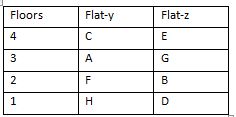
G lives just below E’s flat such that both live in the same type of flat. F and H live in the same type of flat such that F lives just above H’s floor and lives immediate west of B. D does not live in flat which is adjacent to F’s flat. 4. C lives on a floor above B. So, B must live in flat – Z of floor – 2 as F lives immediate west of B and F lives above the floor on which H lives, which means C lives on topmost floor in flat – Y. Now, E and G lives in same flat and G live below E which means G must live on floor – 3 in flat – Z and E lives on 4th floor in flat – Z. Now, D and F do not live in same flat which means D must live on ground floor in flat –Z so, H must live on ground floor in flat – Y. The final arrangement is as follows:
Under which of the following five functions of management, job descriptions and job specifications will fall under?
Strategic decisions are _______
Which of the following theory says that investors value gains and losses differently, placing more weight on perceived gains versus perceived losses?
Why is it necessary to eliminate other solutions in the decision-making process?
Which of the following is not a quantitative technique of decision making?
_____________Â refer to decisions that employees make each day to make the organization run.
______ is a decision-making process in which an individual makes a choice that is satisfactory rather than optimal.
As per Herbert’s Decision-making theory, the stage in which the final decision is made is referred to as ______
Rational decision making is a multi-step process starting with defining the problem. What is the next step in this process?
How does a cost-benefit analysis contribute to selecting the best solution?
