


Question
How many persons between I and the one who joined company in November 23?
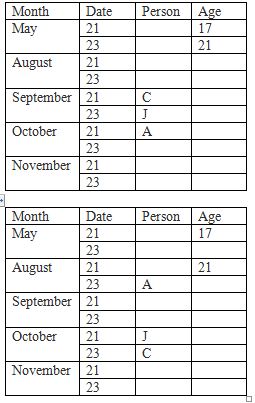
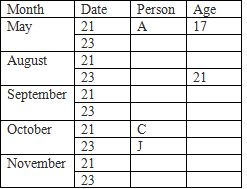 There were 4 persons who joined the company between H and the one who was aged 35 years old G was aged twice as that of E who joined the office just after H
 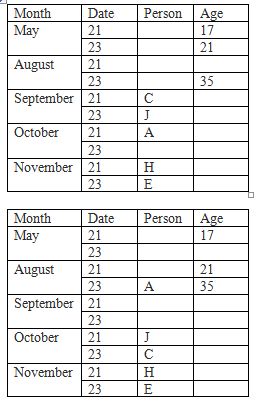 I joined the office just after F.F joined the company on a 23 rd . D joined immediately before G (simulataneoulsy not possible so this CASE 1 is eleminated.)
 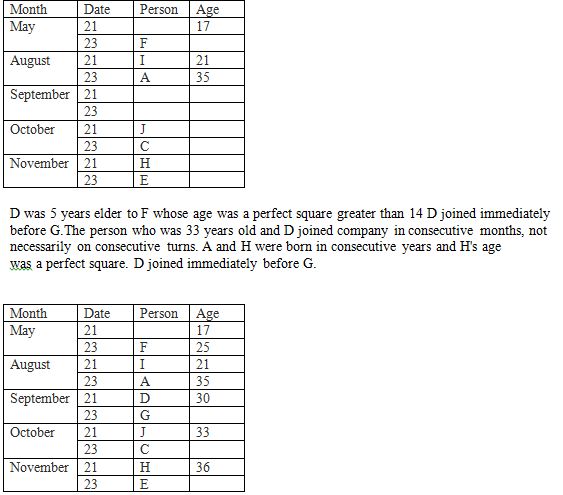 The number of persons, who joined before I, was equal to the number of persons who joined after the one who was aged 29 years. 15. E was elder to I and they were born in consecutive years. The eldest person was 44 years old.G was aged twice as that of E
 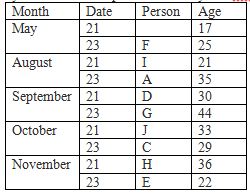 So the final arrangement is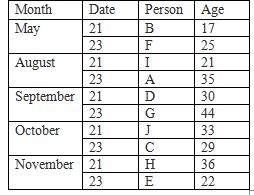
More Puzzles Questions
- Which of the following is one of the choices of David?
- Who among the following person goes on 17th March?
- Which of the following other boxes are placed in a stack where H is placed?
- How many boxes are placed between G and I?
- __ and __ live on same floor.
- Who worked in eBay and in which day of the week?
- Who among the following lives on the fifth floor?
- Statements: Z ≤ Y < E < I; O > P > V > Q = I; Conclusions: I) Y > O II) Q > Z
- How many people live between the one who likes Sony and Dell?
- Who among the following lives immediately below B?
Hey! Ask a query
Please enter email id
The email must be a valid email address.
Please enter Mobile Number
Please enter valid Mobile Number
Please enter your Doubt

Think You're Ready for RBI Grade B?
RBI Grade B 2026 Phase 1 Memory Based Paper
- 200 Questions with Detailed Solutions
- Section-wise Coverage (GA, English, Quant & Reasoning)