


Question
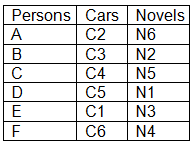
Six persons A, B, C, D, E and F have one different cars namely C1, C2, C3, C4, C5 and C6 (not necessarily in the same order). Each also likes a different Novel namely N1, N2, N3, N4, N5 and N6 (not necessarily in the same order). C has C4. A does not have C6. B likes N2. The one who has C2 likes N6. F does not have C5. A does not like N1. E has C1 and he likes N3. The one who has C6 likes N4. The one who has C5 likes N1. Which of the following statement(s) is/are correct?
Six persons A, B, C, D, E and F have one different cars namely C1, C2, C3, C4, C5 and C6 (not necessarily in the same order). Each also likes a different Novel namely N1, N2, N3, N4, N5 and N6 (not necessarily in the same order). C has C4. A does not have C6. B likes N2. The one who has C2 likes N6. F does not have C5. A does not like N1. E has C1 and he likes N3. The one who has C6 likes N4. The one who has C5 likes N1. Which of the following statement(s) is/are correct?
I. C likes N5.
II. A has C2.
III. F has C6.
IV. D likes N1.
More Previous year papers Questions
- If in a code language, 'HOME' is written as 'LROF' and 'EYE' is written as 'HAF' and 'SO' is written as 'UP', how will 'HOUSE' be written in that language?
- Identify the figure that completes the given pattern. 1. 2. 3. 4.
- Which two signs should be interchanged to make the given equation correct? 28 +12 – 21 ÷ 7 × 4 = 60
- Which letter-cluster will replace the question mark (?) to complete the given series? TUWA, ?, RISI, QEQO, PAOU
- Select the correct water image of the given figure.
- Identify the figure given in the options which when put in place of the question mark (?) will logically complete the series?
- Select the word-pair that best represents a similar relationship to the one expressed in the pair of words given below. (The words must be considered as me...
- L is the wife of Q. P is the mother of M. J is the father of L. M is the sister of H. J is the husband of H. How is P related to L?
- Read the question and statements given below and then select the correct option. Question: Who is the lightest among P, Q, R, S & T? Statement I. S is li...
- Kamya and Vedika start walking from two different points. Kamya walks 14m from Point-A towards the east, then turns right and walks 7m. Then she turns left...
Relevant for Exams:
Hey! Ask a query
Please enter email id
The email must be a valid email address.
Please enter Mobile Number
Please enter valid Mobile Number
Please enter your Doubt

Think You're Ready for RBI Grade B?
RBI Grade B 2026 Phase 1 Memory Based Paper
- 200 Questions with Detailed Solutions
- Section-wise Coverage (GA, English, Quant & Reasoning)