


Question
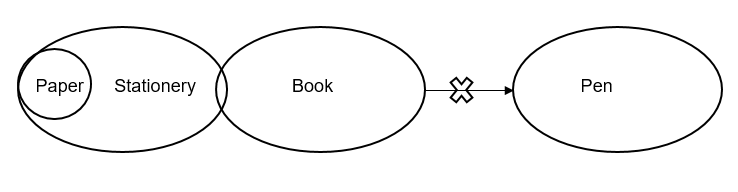
Statements: 1. All papers are stationery. 2. Some stationery are books. 3. No book is a pen. Conclusions :
Statements: 1. All papers are stationery. 2. Some stationery are books. 3. No book is a pen. Conclusions :
I. Some pens are books.
II. No paper is a pen.
III. Some stationery are papers.
More Previous year papers Questions
- Select the correct option that indicates the arrangement of the given words in a logical and meaningful order. 1. Shirt piece 2. Thread 3. Fabric 4. Shirt ...
- Select the combination of letters that when sequentially placed in the blanks of the given letter series will complete the series. A_C0_ _ A_ _ OST_ _ CO...
- In this question, a statement is followed by two courses of action, numbered I and II. You must assume everything in the statement to be true and on the ba...
- Select the letter-cluster from among the given options that can replace the question mark (?) and continue the given series. KWX, NSA, QOD, TKG, WGJ, ?
- In certain code language. 'You are bad' is written as 'YO LO PO', 'Schools are bad' is written as 'NO PO YO', and 'You are human' is written as 'LO PO RO'....
- Question 6
- If in a special code language DEMOCRAT is written as FCOMEPCR, then what will be the code for MONARCHY in that code language?
- Given below is a question followed by two statements I and II. Read both the statements carefully to decide which one of them is sufficient to answer the q...
- Pointing to a girl, a lady said, "She is my mother's husband's second son's wife's daughter." How is the girl related to the lady?
- Complete the sequence with the correct option from the following codes: EGIK : FILO :: FHJL : ?
Relevant for Exams:
Hey! Ask a query
Please enter email id
The email must be a valid email address.
Please enter Mobile Number
Please enter valid Mobile Number
Please enter your Doubt

Think You're Ready for RBI Grade B?
RBI Grade B 2026 Phase 1 Memory Based Paper
- 200 Questions with Detailed Solutions
- Section-wise Coverage (GA, English, Quant & Reasoning)