


Question
Among six persons F, G, H, I, J, and K, who is second tallest?
Among six persons F, G, H, I, J, and K, who is second tallest?
I. F is shorter than only two persons and I is taller than only J.
II. H is taller than only two persons, I is taller than H but shorter than G. K is the tallest.
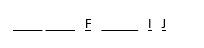 Statement I alone is not sufficient to answer the question. From II, K G I H F/J F/J G is the second tallest. Hence Statement II alone is sufficient to answer the question.
More Data Sufficiency Questions
- What is the code for ‘auto’ in the code language in which ‘giant segment the spot’ is written as ‘sag map pap rap’? I. In that code language ‘the auto gia...
- How is P related to G? I. P is the mother of the only brother in law of G’s sister in law. II. M is the daughter of G’s sister in law who is the only dau...
- The question given below consists of two statements numbered I and II given below it. You have to decide whether the data provided in the statements are su...
- There are 7 friends P, Q, R, S, T, U and V of different ages. Is T the second youngest person? I. S is older than U. R is older than 2 persons. II. T is...
- The question given below consists of two statements numbered I and II below them. You have to decide whether the data provided in the statements are suffic...
- What is Guna's age? I. Guna, Vinay and Keshav are all of the same age. II. Sum of ages of Vinay, Keshav and Arjun is 32; also, Arjun is as old as Vinay ...
- The question given below consists of two statements numbered I and II given below it. You have to decide whether the data provided in the statements are su...
- Among six persons F, G, H, I, J, and K, who is second tallest? I. F is shorter than only two persons and I is taller than only J. II. H is taller than o...
- Eight persons, P, Q, R, S, T, U, V and W are sitting in a row. All of them are facing the north. Who is sitting at the extreme left end? Statements: I. Thr...
- The question given below consists of two statements numbered I and II given below it. You have to decide whether the data provided in the statements are su...
Relevant for Exams:
Hey! Ask a query
Please enter email id
The email must be a valid email address.
Please enter Mobile Number
Please enter valid Mobile Number
Please enter your Doubt

Think You're Ready for RBI Grade B?
RBI Grade B 2026 Phase 1 Memory Based Paper
- 200 Questions with Detailed Solutions
- Section-wise Coverage (GA, English, Quant & Reasoning)