


Question
Among E, G, H, I, J and K, who is second to the left of G if all are sitting around a circular table facing the centre.
Among E, G, H, I, J and K, who is second to the left of G if all are sitting around a circular table facing the centre.
I. J sits third to left of G, who is not an immediate neighbour of K. H is second to the left of K.
II. I sits opposite to J and is the immediate neighbour of K and E. H is sitting immediate right of E.
Each of the questions below consists of a question and two statements numbered I and II are given below. You have to decide whether the data provided in the statements are sufficient to answer the question. Read both the statements and –
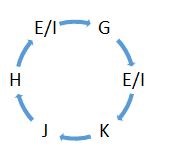 K is sitting second to the left of G. From II,
 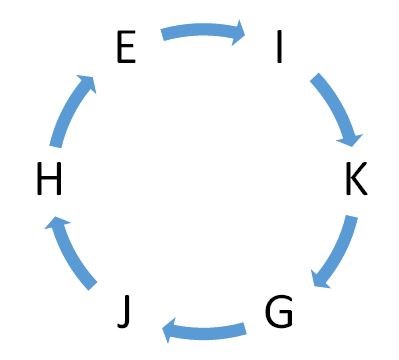 H is sitting second to the left of G.
More Seating Arrangement Questions
- What is difference between weight of I and L?
- If O sits third to the right of F then how many persons are sitting between O and J?
- If all the persons are made to sit in alphabetical order in a clockwise direction with respect to Q, then how many persons remain unchanged in their positi...
- Seven persons are sitting in a row. B is sitting with E and G, D is sitting with G and H, who is sitting with D and F and E is sitting with C and B. Who is...
- Six persons (N, O, P, Q, R and S) sit in a linear row and face in north direction. Q sits third to the right of P. Only R sits to the right of S. O sits to...
- Six laptops, M, N, O, P, Q and R, are placed in a row facing towards the north (not necessarily in the same order). M is placed to the immediate left of R....
- Four of the following five are alike in a certain way and hence form a group. Who among the following person does not belong to that group?
- Who among the following are the immediate neighbours of Sonam?
- Eight persons N, O, P, Q, R, S, T and U sit in a row facing north direction. S sits second to the left of Q, who is not extreme right end. P is second pers...
- Who likes grey color?
Relevant for Exams:
Hey! Ask a query
Please enter email id
The email must be a valid email address.
Please enter Mobile Number
Please enter valid Mobile Number
Please enter your Doubt

Think You're Ready for RBI Grade B?
RBI Grade B 2026 Phase 1 Memory Based Paper
- 200 Questions with Detailed Solutions
- Section-wise Coverage (GA, English, Quant & Reasoning)