


Question
Count the number of squares in the given figure.
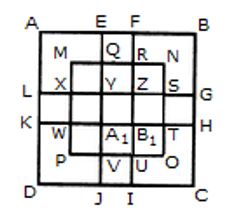 The simplest squares are EFRQ, MQYX, QRZY, RNSZ, LXWK, XYA1W, YZB1A1, ZSTB1, SGHT, WA1VP, A1B1UV, B1TOU and VUIJ i.e. 13 in number. The squares having two components each are AEYL, FBGZ, KA1JD and B1HCI i.e. 4 in number. The squares having four components each are MRB1W, QNTA1 XZUP and YSOV i.e. 4 in number. The squares having seven components each are AFB1K, EBHA1 LZID and YGCJ i.e. 4 in number. There is only one square i.e. MNOP composed of nine components. There is only one square i.e. ABCD composed of seventeen components. There are 13+ 4 + 4 + 4+1 + 1 = 27 squares in the figure.
More Counting Of Figures Questions
- Find the number of triangles in the given figure:
- How many triangles are there in the given figure?
- Find the number of triangles in the given figure?
- Find the number of triangles in the given figure?
- How many triangles are there in the given figure?
- How many triangles are there in the figure?
- In the adjoining figure, if the centres of all the circles are joined by horizontal and vertical lines, then find the number of squares that can be formed.
- Find the number of triangles in the given figure.
- Find the number of triangles in the given figure.
- What are the minimum numbers of lines required to form the given figure?
Relevant for Exams:
Hey! Ask a query
Please enter email id
The email must be a valid email address.
Please enter Mobile Number
Please enter valid Mobile Number
Please enter your Doubt

Think You're Ready for RBI Grade B?
RBI Grade B 2026 Phase 1 Memory Based Paper
- 200 Questions with Detailed Solutions
- Section-wise Coverage (GA, English, Quant & Reasoning)