


Question
Who among the following lives on floor number 6?
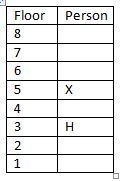 U lives on an odd numbered floor but not on floor number 7. Only two persons live between U and Y. Y does not live on the topmost floor. We can use the above information to place U and Y in the table as shown below.
 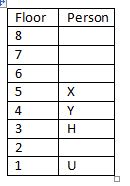 B lives immediately below Z. Neither B nor C lives on floor number 6. After using the above information we can place B, Z and C in the table and here we can see that there is only spot left on the table which will be filled by last remaining member i.e. D.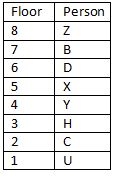
More Classification Questions
- Choose the figure which is different from the rest.
- (A) Soybeans (B) Flax Seeds (C) Jowar (D) Mustard
- Number of letter skipped between adjacent letters in the series decreased by one. Find out the series that is in this sequence?
- Question 4
- What is the difference between the floor numbers of X and Y?
- Choose the figure which is different from the rest.
- Select the one which is different from the other three responses.
- Select the one which is different from the other three responses.
- Choose the figure which is different from the rest.
- Choose the figure which is different from the rest.
Relevant for Exams:
Hey! Ask a query
Please enter email id
The email must be a valid email address.
Please enter Mobile Number
Please enter valid Mobile Number
Please enter your Doubt

Think You're Ready for RBI Grade B?
RBI Grade B 2026 Phase 1 Memory Based Paper
- 200 Questions with Detailed Solutions
- Section-wise Coverage (GA, English, Quant & Reasoning)